
Memory as Fragmented Body
Anonymous Art reconstructs the human figure through the language of ancient echo and modern rupture.
I return, again, to Anonymous—an artist I have followed for some time, and one I continue to regard as a rare source of fresh air within the visual language of the 21st century. There is a persistence in this practice, a refusal to resolve too quickly, that feels increasingly vital.
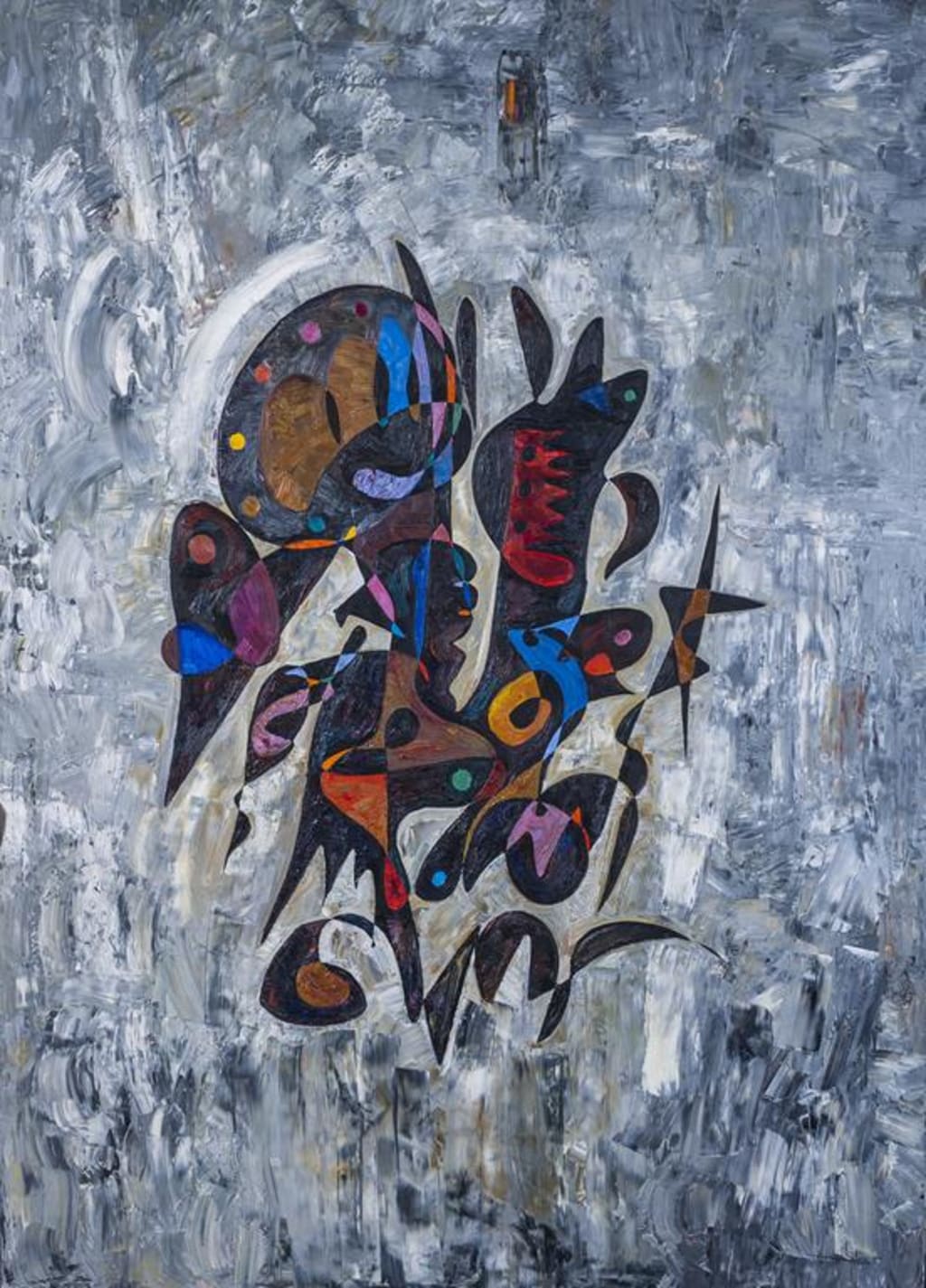
In Babylonian Human (2016), that sensibility deepens.
The title reaches backward—toward antiquity, toward one of the earliest recorded civilizations—yet the painting itself resists any direct historical reference. There are no ruins, no inscriptions, no narrative markers. Instead, the work proposes something more elusive: not history depicted, but history absorbed and reconfigured through form.
The subject is introduced through language.
The painting then constructs an abstract equivalent.
At the center of the canvas, a vertical configuration of interlocking shapes suggests a figure without ever stabilizing into one. Dark, curving forms create a loose armature, within which passages of saturated color—crimson, cobalt, ochre, and violet—emerge like embedded signals. Circular elements read as eyes or medallions; elongated shapes hint at limbs or torsos; yet each suggestion dissolves as quickly as it appears.
The figure is both present and withheld.
Set against a heavily worked grey-blue ground, the central structure appears suspended—neither fully integrated into its environment nor entirely separate from it. The background, with its layered, almost weathered surface, evokes erosion, time, and accumulation. It feels less like space and more like duration.
This tension is central to the work.
“Babylonian” invokes origin, foundation, the early construction of human systems—language, law, architecture. “Human” suggests embodiment, individuality, presence. Yet here, the human is not whole. It is assembled from fragments, as though retrieved from across time and reorganized into a contemporary syntax.
The painting seems to hold multiple temporalities at once.
Ancient reference and modern abstraction collapse into a single structure. The figure becomes an artifact—not preserved, but reimagined. Its identity is not fixed; it is continuously negotiated through the relationships between its parts.
As with other works by this anonymous painter, meaning does not arrive through depiction. It emerges through arrangement—through the careful balancing of form, color, and tension. The absence of biographical context only sharpens this focus, returning attention to the work itself as a site of inquiry.
It does not reconstruct the past.
It reframes it.
In Babylonian Human (2016), the human figure becomes a vessel for time—fragmented, layered, and unresolved.
The result is neither portrait nor relic, but something more complex:
a body assembled from memory,
held together
by abstraction.
About the Creator
Thelma Golden
American art curator, the director and chief curator of The Studio Museum in Harlem.
Keep reading
More stories from Thelma Golden and writers in Art and other communities.
How Strategic Partnerships Are Shaping the Future of Digital Growth
In today’s fast-moving digital economy, businesses are constantly seeking smarter ways to scale, innovate, and stay competitive. Strategic collaborations like allied edge partnerships are becoming essential tools for organizations aiming to unlock new opportunities without overextending resources. These alliances allow companies to combine expertise, share risks, and accelerate progress in ways that traditional growth models often fail to achieve.
By Ayush Bagwari7 days ago in Art
The Static Hour #7
The night rain hammered against the rusted wire fence, the dripping sounds grating in the deep darkness. Puddles spread across the muddy path, reflecting distorted, fragmented light, as if time itself had disintegrated here, abandoned in the silent, rainy night.
By Water&Well&Page2 days ago in Art



Comments
There are no comments for this story
Be the first to respond and start the conversation.