
The Art of Ornament
Exploring the Evolution, Philosophy, and Beauty of Islamic Artistic Expression

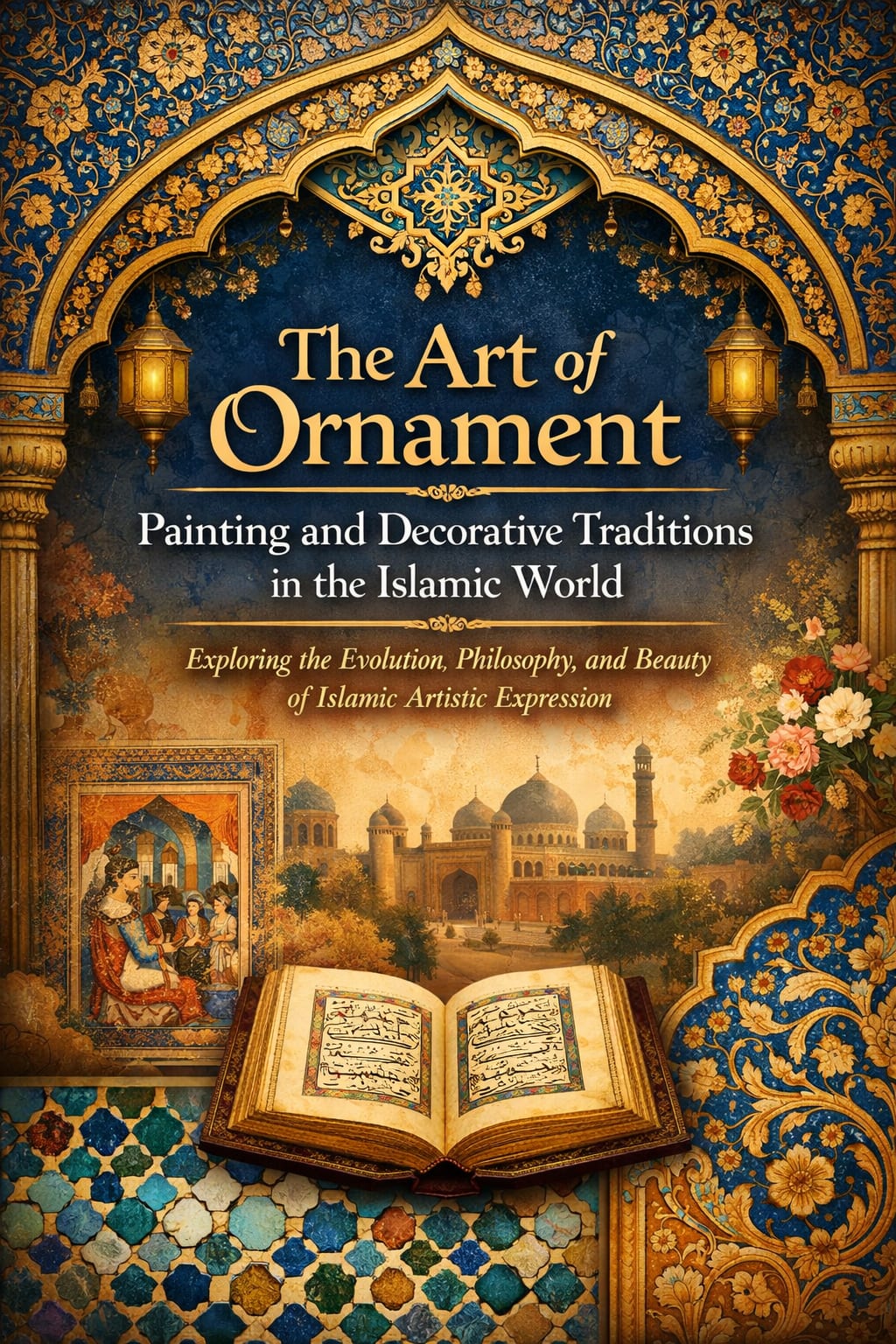
The world of Islamic art is rich, diverse, and deeply rooted in both spiritual and cultural traditions. Among its many forms, painting and decorative arts—often referred to as “naqashi”—hold a unique place. Unlike Western artistic traditions that emphasize realism and human depiction, Islamic painting developed its own distinctive language, shaped by religious values, regional influences, and a profound appreciation for geometry, nature, and symbolism.
At the heart of Islamic Art lies a philosophy that seeks to reflect the infinite nature of the divine. This idea is often expressed through intricate patterns, repeating motifs, and carefully balanced compositions. Instead of focusing on the physical representation of living beings, artists turned their attention to abstract designs, calligraphy, and stylized forms of nature. This approach not only aligned with religious sensibilities but also gave rise to a unique aesthetic that continues to inspire the world today.
One of the most prominent forms of Islamic painting is miniature art. Flourishing particularly in regions such as Persia, Central Asia, and the Indian subcontinent, miniature paintings were often used to illustrate manuscripts, historical chronicles, and literary works. These paintings were characterized by their fine detail, vibrant colors, and imaginative compositions. Persian miniatures, for example, frequently depicted scenes from epic poetry, royal courts, and gardens, blending reality with fantasy in a harmonious visual narrative.
The influence of empires such as the Mughal Empire played a significant role in the development of painting traditions. Mughal artists combined Persian techniques with local Indian styles, resulting in a more naturalistic approach. Their paintings often included portraits of emperors, court scenes, and depictions of everyday life, showcasing a balance between artistic innovation and cultural storytelling.
Calligraphy is another central element of Islamic naqashi. More than just a means of writing, calligraphy became a revered art form, especially when used to transcribe verses from the Qur’an. The beauty of Arabic script, with its flowing lines and rhythmic patterns, allowed artists to transform words into visual masterpieces. This fusion of language and art elevated calligraphy to a spiritual level, making it one of the most respected forms of artistic expression in the Islamic world.
Geometric patterns are equally significant in Islamic decorative art. These patterns, often found in architecture, textiles, and manuscripts, are based on mathematical precision and symmetry. Artists used simple shapes such as circles, squares, and stars to create complex designs that could extend infinitely. This sense of endless repetition symbolized the boundless nature of creation and the unity of God. The mathematical sophistication behind these patterns reflects a deep connection between art and science, a hallmark of the Islamic Golden Age.
Floral and vegetal motifs, commonly known as arabesques, also play a vital role in Islamic painting. These designs are inspired by nature but are often stylized and abstracted. Leaves, vines, and flowers intertwine in flowing compositions, creating a sense of movement and harmony. Unlike realistic botanical illustrations, these motifs are meant to evoke the beauty of paradise, a recurring theme in Islamic culture.
Regional diversity further enriched the tradition of naqashi. In Ottoman Turkey, artists developed a distinctive style that emphasized bold colors and elegant floral designs. In Safavid Persia, painting reached new heights of sophistication, with artists producing highly detailed and imaginative works. Meanwhile, in the Indian subcontinent, the blending of Islamic and local traditions gave rise to a unique artistic identity that can still be seen in modern South Asian art.
Despite changes over time, the essence of Islamic painting has remained consistent: a focus on beauty, balance, and spiritual meaning. Even in contemporary art, many Muslim artists draw inspiration from traditional naqashi, reinterpreting its elements in modern contexts. This continuity highlights the enduring relevance of Islamic artistic principles in a rapidly changing world.
In conclusion, the art of naqashi in the Islamic world is much more than decoration—it is a reflection of a worldview that values harmony, order, and the divine. Through miniature paintings, calligraphy, geometric patterns, and floral designs, Islamic artists have created a legacy that transcends time and geography. Their work not only enriches cultural heritage but also offers a timeless reminder of the power of art to connect the material and the spiritual.
About the Creator
Irshad Abbasi
Ali ibn Abi Talib (RA) said 📚
“Knowledge is better than wealth, because knowledge protects you, while you have to protect wealth.
Keep reading
More stories from Irshad Abbasi and writers in Art and other communities.
The Rise of Glassmaking in the Islamic Era
The craft of glassmaking reached remarkable heights during the period often referred to as the Islamic Golden Age. While glass production existed long before this era in regions such as ancient Egypt and Rome, it was under Islamic rule that the industry truly flourished, blending artistic expression with scientific advancement. From the 8th to the 14th centuries, Muslim artisans and scholars transformed glassmaking into a sophisticated and highly influential craft that would shape industries across Europe and beyond.
By Irshad Abbasi about 3 hours ago in Art
'Till Death We Do Art
There would be nothing divine in this world without art. Nature may surpass the divine to all intents and purposes, but like everything it absorbs and is absorbed by, it remains here, stuck on the surface of this world, ever-present, physically bound to the universe.
By Avocado Nunzella BSc (Psych) -- M.A.P 29 days ago in Art
A Career Shaped by Financial Leadership and Experience
Professional journeys often reflect a combination of education, experience, and the ability to adapt to changing environments. In the world of finance and business leadership, many professionals develop their careers gradually, building expertise through different roles and industries. The professional path of Carolina Guerreno offers an example of how experience across multiple financial positions can contribute to a broader understanding of business operations and financial management.
By Carolina Guerreno2 days ago in Art




Comments
There are no comments for this story
Be the first to respond and start the conversation.