
The Eternal Duel — Baroque vs. Renaissance
How Caravaggio's Revolution Challenged the Divine Harmony of the High Renaissance

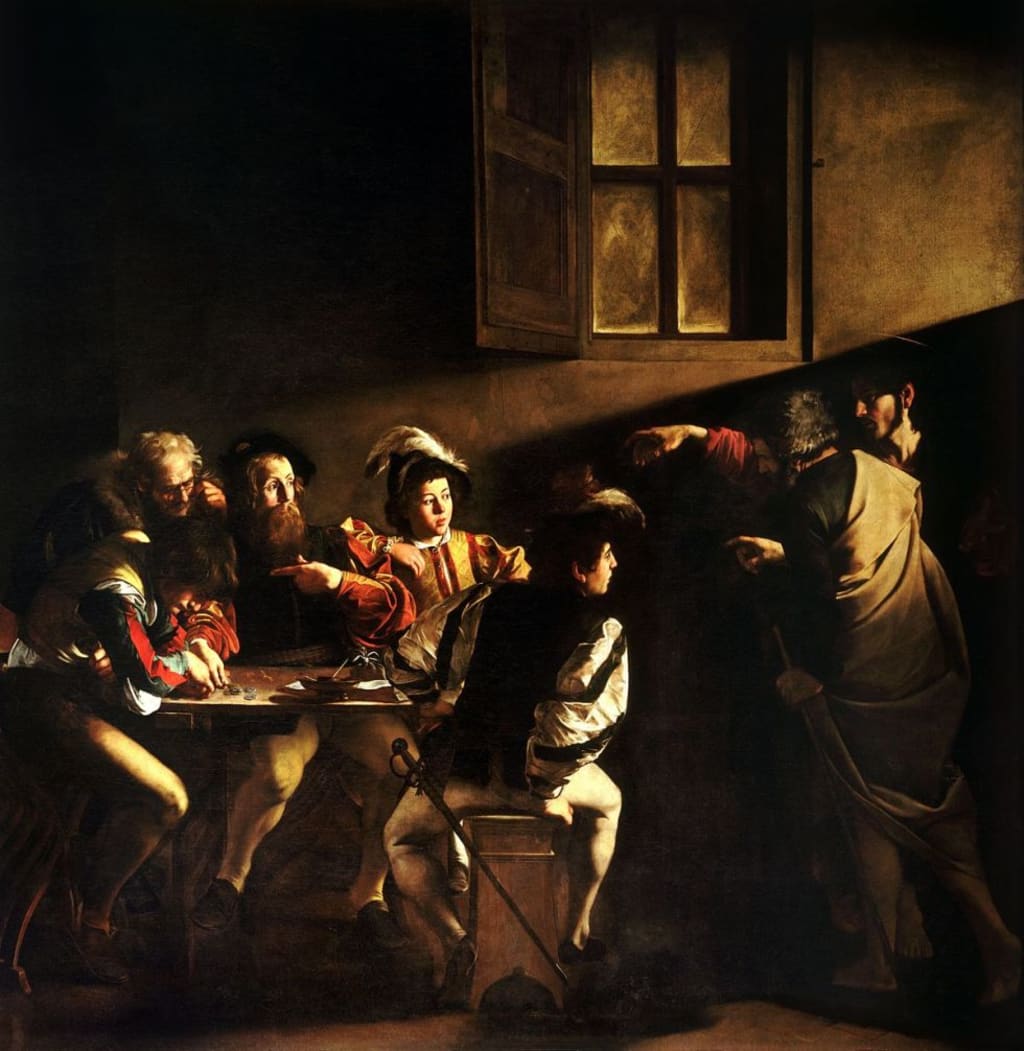
ROME — In the hushed silence of San Luigi dei Francesi church, tourists still jostle for position before three canvases that changed Western art forever. They come seeking the *Calling of Saint Matthew*, the masterpiece that Michelangelo Merisi da Caravaggio completed between 1599 and 1600. What they find is not the ethereal spirituality of the High Renaissance, but something far more disturbing: a divine intervention that looks disturbingly like a shakedown in a backroom gambling den.
Caravaggio didn't just paint differently—he declared war on everything his predecessors held sacred. And in doing so, he created the Baroque era.
The Renaissance Paradise Lost
To understand Caravaggio's revolution, one must first understand what he was destroying. The Renaissance—spanning roughly from the 14th to the early 17th century—had established art's highest purpose as the pursuit of ideal beauty. Leonardo da Vinci's *Mona Lisa*, Raphael's *School of Athens*, and Botticelli's *Birth of Venus* (c. 1485) represented humanity's aspiration toward divine perfection through mathematical precision and classical harmony .
Renaissance artists were the visual theologians of Humanism. They discovered linear perspective, mastered anatomical accuracy, and developed *sfumato*—that hazy, atmospheric technique that made paintings feel like windows onto idealized worlds. Their subjects, whether biblical or mythological, were elevated, idealized, placed in balanced compositions that invited contemplation rather than confrontation .
"The Renaissance discovered humans as independent subjects," notes art historian Alessandro from Exploring Art. "Artists emphasized anatomically accurate, naturalistic portrayals with individual facial features. They aimed to represent their subjects with natural proportions as faithfully as possible" .
But faithful to what? The Renaissance was faithful to an idea—the idea that humanity could achieve perfection through reason, proportion, and the revival of classical antiquity.
Caravaggio looked at this tradition and saw lies.
The Anti-Christ of Art
Born in Milan in 1571, Caravaggio arrived in Rome during the 1590s as a penniless refugee from a plague-ravaged city. He had buried his father at age six, his mother by thirteen. He knew death intimately, and he knew that the world was not the orderly, harmonious place Raphael depicted .
What Caravaggio brought to his canvas was not idealization but *recognition*. He painted the people he saw in Roman streets—beggars, prostitutes, street vendors, laborers with dirty fingernails and weathered faces. When he depicted Saint Matthew, the tax collector didn't look like a Roman senator in pristine robes; he looked like a suspicious bookie counting coins in a tavern, surrounded by rough men in contemporary clothing .
"Caravaggio's most important contribution was his commitment to making art look real," observes the Drawing Academy. "He didn't paint idealized and perfect figures like other artists in the Renaissance. Instead, he looked at ordinary people on the streets of Rome for inspiration" .
This was not merely an aesthetic choice—it was theological dynamite. The Catholic Church, engaged in the Counter-Reformation against Protestantism, needed art that would move the faithful emotionally. The Council of Trent (1545–1563) explicitly instructed that sacred images should educate and inspire devotion, becoming "continually revolving in mind" for believers .
Caravaggio delivered exactly what the Church requested, but in a way that horrified the establishment. His *Death of the Virgin* (c. 1605–1606) was rejected by the commissioning church because Mary looked too dead, too human, too *real*. He had apparently used the corpse of a drowned prostitute as his model for the Mother of God .
The Invention of Tenebrism
If Caravaggio's subjects dragged the divine into the gutter, his technique ensured we couldn't look away. He pioneered *tenebrism*—extreme chiaroscuro where darkness dominates the canvas and light erupts like a theatrical spotlight, isolating figures in pools of illumination against near-black backgrounds .
In the *Calling of Saint Matthew*, Christ enters from the right, his face barely visible, his hand extending in a gesture that echoes Michelangelo's *Creation of Adam*. But this divine moment occurs in a dimly lit room where Matthew sits with tax collectors, counting money. The light doesn't illuminate heavenly clouds—it cuts across a wooden ceiling, catching the faces of men caught between greed and grace .
"Caravaggio captures a spiritual awakening, with only light and gesture identifying these figures as divine," notes the Smarthistory analysis. The beam of light becomes the active agent of salvation, striking Matthew with the force of revelation .
This was cinema before cinema existed. Caravaggio understood that drama happens in the shadows, that revelation requires contrast, that the sacred is most powerful when it invades the profane. Film director Martin Scorsese, whose own work is steeped in Caravaggio's visual language, observed: "Caravaggio's paintings have a cinematic quality; they tell a story through visuals, and I've always been drawn to that narrative power" .
The Baroque Manifesto
Caravaggio didn't merely create paintings—he established the Baroque manifesto. Where Renaissance art sought to elevate viewers toward ideal beauty, Baroque art grabbed them by the collar and demanded emotional participation. Where Renaissance compositions were balanced and horizontal, Baroque compositions were diagonal, dynamic, unstable. Where Renaissance lighting was even and atmospheric, Baroque lighting was theatrical and confrontational .
The Baroque era that followed—encompassing masters like Bernini, Rubens, and Rembrandt—took Caravaggio's innovations and expanded them into architecture, sculpture, and music. But the DNA remained the same: emotion over reason, drama over harmony, experience over contemplation .
"The Baroque took the naturalistic achievements of the Renaissance and ramped them up for heightened theatricality and dramatic effect," explains Rosie Lesso for The Collector. "Key features are high contrast, stark lighting, elongated bodies, and exaggerated elements of motion" .
The Eternal Contemporary
Four centuries after his death in 1610—likely from fever while fleeing a murder charge in Rome—Caravaggio remains disturbingly contemporary. His influence echoes through Francis Bacon's screaming popes, through the gritty street photography of Diane Arbus and Nan Goldin, through the chiaroscuro cinematography of Quentin Tarantino and Paul Schrader .
We live in a Caravaggio world. We distrust idealization. We value authenticity over perfection. We understand that divinity appears not in golden halos but in unexpected moments—in taverns, in gutters, in the faces of the marginalized. We know that light is most meaningful when it emerges from darkness.
The Renaissance gave us the *idea* of perfection. Caravaggio gave us the *experience* of being human—flawed, desperate, caught between shadow and sudden, blinding grace.
In San Luigi dei Francesi, the tourists continue to gather. They point their phones at the canvas where Saint Matthew points to himself in disbelief, asking "Me?" The light catches his weathered face, his rough clothing, his essential, undeniable humanity. And in that moment, across four centuries, Caravaggio still asks us the same question: Can you see the divine in the gutter? Can you recognize grace in the shadows?
The Renaissance wanted us to look up. Caravaggio demanded we look directly—and we haven't stopped looking since.
*
About the Creator
Mark Senegal
Mark is a passionate blogger who writes about a wide range of topics, from lifestyle and culture to technology, travel and everyday trends.
Keep reading
More stories from Mark Senegal and writers in Art and other communities.
Digital art and artificial intelligence: a new era of creativity
Digital art has moved far beyond its early status as a specialised practice used mainly by designers, illustrators and experimental creators. It now occupies a central place in contemporary visual culture and shapes the way images are produced, shared and understood across society. Its influence can be seen in advertising campaigns, films, fashion collections, books, architecture, video games and social media. What was once viewed as a technical niche has become a major creative force, changing not only artistic tools but also the meaning of artistic production itself.
By Mark Senegalabout 5 hours ago in Art
'Till Death We Do Art
There would be nothing divine in this world without art. Nature may surpass the divine to all intents and purposes, but like everything it absorbs and is absorbed by, it remains here, stuck on the surface of this world, ever-present, physically bound to the universe.
By Avocado Nunzella BSc (Psych) -- M.A.P 29 days ago in Art
Essential Traditional Performance Arts Around the World for Curious Travelers
Traditional performance arts are powerful cultural expressions that connect communities to their history and identity. Through dance, music, theater, and ceremonial storytelling, societies share values, beliefs, and experiences that have shaped their heritage. These performances often combine artistic creativity with historical traditions preserved across generations.
By Producer James Simon7 days ago in Art



Comments
There are no comments for this story
Be the first to respond and start the conversation.