
THE ENTROPIC CIVILISATION, THE MISCOMMUNICATION TRILOGY, “The Entropy of Communication, Vol. II”, part 1
Book Review

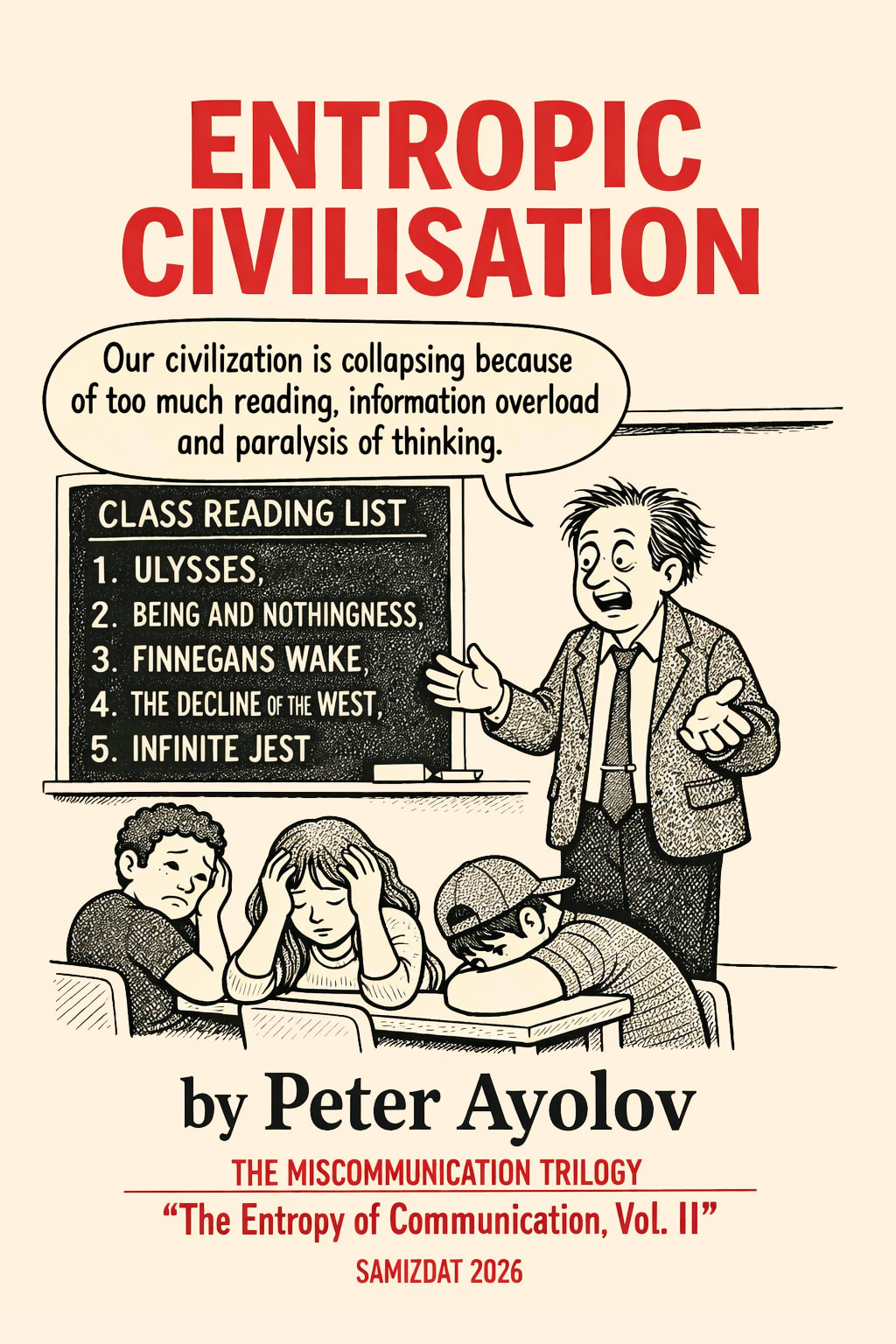
Review- Entropic Civilisation: At the Edge of Linguistic Collapse
Few ideas are as deceptively simple and yet as intellectually provocative as the claim that civilisation is built not on armies, machines, or markets, but on language. Entropic Civilisation develops precisely such a thesis and expands it into a wide-ranging diagnosis of contemporary society. The book proposes that language is the fundamental technology through which human societies organise themselves, yet it is also the fragile mechanism that eventually contributes to their decline. What begins as a tool of order gradually becomes a generator of disorder. Civilisations rise through language, but they may also fall through it. The central argument rests on the concept of communication entropy. Borrowed from thermodynamics and information theory, entropy refers to the tendency of systems to move from order toward disorder. Applied to language and communication, the concept describes a process in which communication expands in quantity while declining in clarity. Societies produce ever more messages, narratives, and symbols, yet genuine understanding becomes increasingly difficult. The paradox of modern civilisation is therefore not the disappearance of language but its excess. People speak more, write more, publish more, and transmit more information than ever before, yet meaning appears increasingly unstable. The book situates this problem within a broad historical framework. Civilisations have always relied on official languages to establish social order and political legitimacy. Latin served as the administrative and legal foundation of the Roman Empire. Classical Chinese supported the bureaucratic continuity of imperial China for centuries. Arabic became the intellectual and religious medium of Islamic civilisation. In each case language functioned as the operating system of society, allowing large populations to coordinate their actions and imagine themselves as part of a shared cultural universe. However, these linguistic systems were never permanent. Words acquire authority only as long as people continue to believe in their meanings. Over time, political slogans, ideological narratives, and institutional vocabularies lose their persuasive force. Concepts that once inspired loyalty become empty formulas repeated without conviction. At this stage language continues to circulate but its meaning weakens. The result is a peculiar condition in which the structures of civilisation remain intact while the language that sustains them begins to hollow out.
This moment marks the beginning of communicational entropy. Institutions still operate through established linguistic frameworks, yet those frameworks no longer carry the same legitimacy. Laws remain written but lose moral authority. Political speeches are delivered constantly but persuade fewer listeners. Public discourse becomes saturated with repetition and competing narratives. The civilisation appears stable on the surface while its linguistic foundations quietly deteriorate. One of the most compelling metaphors used throughout the book is the story of the Tower of Babel. The biblical narrative describes humanity attempting to construct a unified civilisation through a single language. Communication becomes the tool through which people coordinate their ambition and expand their collective power. Yet the project collapses when language fragments. Babel therefore represents a structural truth about civilisation: the unity of society depends on shared meaning, and when language disintegrates the social order follows. The modern world, the author argues, may be experiencing a new form of Babel. Digital technologies have created global communication networks that connect billions of people in real time. At first glance such connectivity appears to promise unprecedented understanding between cultures and societies. Yet the book suggests that the opposite dynamic is unfolding. Instead of producing consensus, digital communication multiplies ideological dialects, cultural conflicts, and rival narratives.
Social media platforms provide the clearest illustration of this process. These networks generate enormous volumes of communication while simultaneously encouraging fragmentation. Communities organise themselves around shared ideological vocabularies that isolate them from competing perspectives. Each group develops its own linguistic codes, references, and narratives. Communication becomes abundant but mutual understanding declines. In this environment language often functions less as a bridge between individuals and more as a weapon of identity and conflict. Words are used to mobilise allies and provoke opponents rather than to clarify ideas. Public discourse shifts away from deliberation and toward confrontation. Political language increasingly signals group loyalty rather than encouraging collective reasoning. The book describes this transformation as the movement from manufacturing consent to manufacturing dissent. Earlier mass communication systems attempted to create unified narratives capable of stabilising political authority. Contemporary digital communication, however, often thrives on division. Conflicting narratives attract attention, generate engagement, and drive the economic logic of online platforms. Outrage, fear, and ideological confrontation become profitable emotional resources within the digital economy.
This economic dimension deepens the analysis. Communication is no longer simply a cultural phenomenon but also a commodity. Every message, comment, or post becomes a piece of data that can be analysed, monetised, and integrated into advertising systems. The more intense the conflict within public discourse, the greater the engagement produced by these platforms. Miscommunication, paradoxically, becomes economically valuable. Historical examples in the book further illustrate how linguistic systems influence political structures. The transformation of Latin after the fall of the Roman Empire demonstrates how languages can survive political collapse as “living dead languages.” Latin did not disappear when Rome fell. Instead it fossilised, surviving within religious institutions and scholarly traditions while vernacular languages developed around it. The persistence of Latin prolonged the cultural influence of Rome long after its political authority vanished. Similar patterns appear elsewhere in history. French once dominated diplomatic communication across Europe, while English eventually emerged as the global language of science, commerce, and technology. These lingua franca languages often outlive the empires that promoted them. Linguistic influence therefore extends far beyond political power.
The book also examines attempts by political regimes to consciously reshape language in order to maintain authority. Revolutionary movements frequently attempt to transform vocabulary and rhetoric so that language itself reflects ideological change. Yet such efforts rarely succeed indefinitely. Linguistic systems evolve through social interactions that cannot be fully controlled by governments or institutions. When official discourse becomes too rigid or detached from everyday experience, alternative vocabularies emerge. Another important theme concerns the crisis of trust in language itself. In earlier historical periods official texts and institutional communication often carried an assumption of reliability. Today that assumption has weakened dramatically. Disinformation, propaganda, and algorithmically amplified narratives contribute to a climate in which many individuals distrust public communication altogether. This erosion of trust produces a self-reinforcing cycle. When individuals no longer believe official discourse they retreat into smaller communities whose narratives appear more credible. Yet these communities often reinforce their own internal vocabularies and interpretations, further fragmenting the wider public sphere. Communication expands while shared meaning becomes increasingly fragile.
Despite its critical perspective, the book does not portray communicational entropy as purely destructive. Periods of linguistic instability have historically produced intellectual and cultural innovation. New languages, new cultural frameworks, and new philosophical traditions often emerge from the breakdown of older systems. Disorder can therefore become a catalyst for renewal. What distinguishes the present moment, however, is the scale and speed of linguistic change. Digital communication technologies accelerate the production and circulation of language to an unprecedented degree. The challenge facing contemporary societies is therefore not simply how to communicate more efficiently but how to preserve meaning within an environment saturated with messages. Entropic Civilisation ultimately offers a powerful reminder that communication is not merely a technical process of transmitting information. It is the foundation upon which social reality itself is constructed. When language functions effectively it enables cooperation, knowledge transmission, and political organisation. When it loses coherence it undermines the very institutions it once sustained.
The book therefore provides a compelling framework for understanding many of the tensions that define contemporary society. Political polarisation, declining trust in institutions, the rise of disinformation, and the fragmentation of public discourse can all be interpreted as symptoms of a deeper linguistic crisis. By examining the historical relationship between language and civilisation, the work challenges readers to reconsider the role of communication in shaping the future of societies. If civilisations are built through language, then the preservation of meaningful discourse becomes one of the most important tasks facing modern culture. The survival of social order may depend not only on economic or political reforms but on the ability to restore credibility, depth, and responsibility to public language itself. In this sense Entropic Civilisation is more than a study of communication theory. It is a meditation on the fragile architecture of civilisation. Words create the structures through which societies organise themselves, yet those structures remain vulnerable to the slow erosion of meaning. The book suggests that the fate of civilisation may ultimately depend on whether humanity can learn to manage the entropy of its own language.
About the Creator
Peter Ayolov
Peter Ayolov’s key contribution to media theory is the development of the "Propaganda 2.0" or the "manufacture of dissent" model, which he details in his 2024 book, The Economic Policy of Online Media: Manufacture of Dissent.
Keep reading
More stories from Peter Ayolov and writers in BookClub and other communities.
The Perverse Language
When Words Turn Against Meaning: A Review of The Perverse Language The Perverse Language, the fourth and concluding part of Volume I in THE MISCOMMUNICATION TRILOGY, represents the most uncompromising stage of Peter Ayolov’s inquiry into the condition of contemporary communication. If the earlier parts of the volume explore the planned obsolescence of language, the conspiratorial nature of speech, and the emergence of anti-languages, this book confronts a more disturbing development: the inversion of language itself. Here, speech does not merely decay or fragment; it becomes structurally perverse — detached from shared reference, sincerity, and ethical accountability.
By Peter Ayolov11 days ago in BookClub
7 Books That Teach You a Little About Everything
In a world overflowing with information, the most valuable skill isn’t simply knowing facts—it’s understanding how different ideas connect. The greatest thinkers throughout history, from Leonardo da Vinci to modern polymaths, cultivated curiosity across many disciplines: science, philosophy, psychology, economics, history, and technology.
By Diana Meresc2 days ago in BookClub


Comments
There are no comments for this story
Be the first to respond and start the conversation.