
THE RELIGION OF LITERATURE, THE MISCOMMUNICATION TRILOGY, “The Entropy of Communication, Vol. II”, Part 5
Book Review

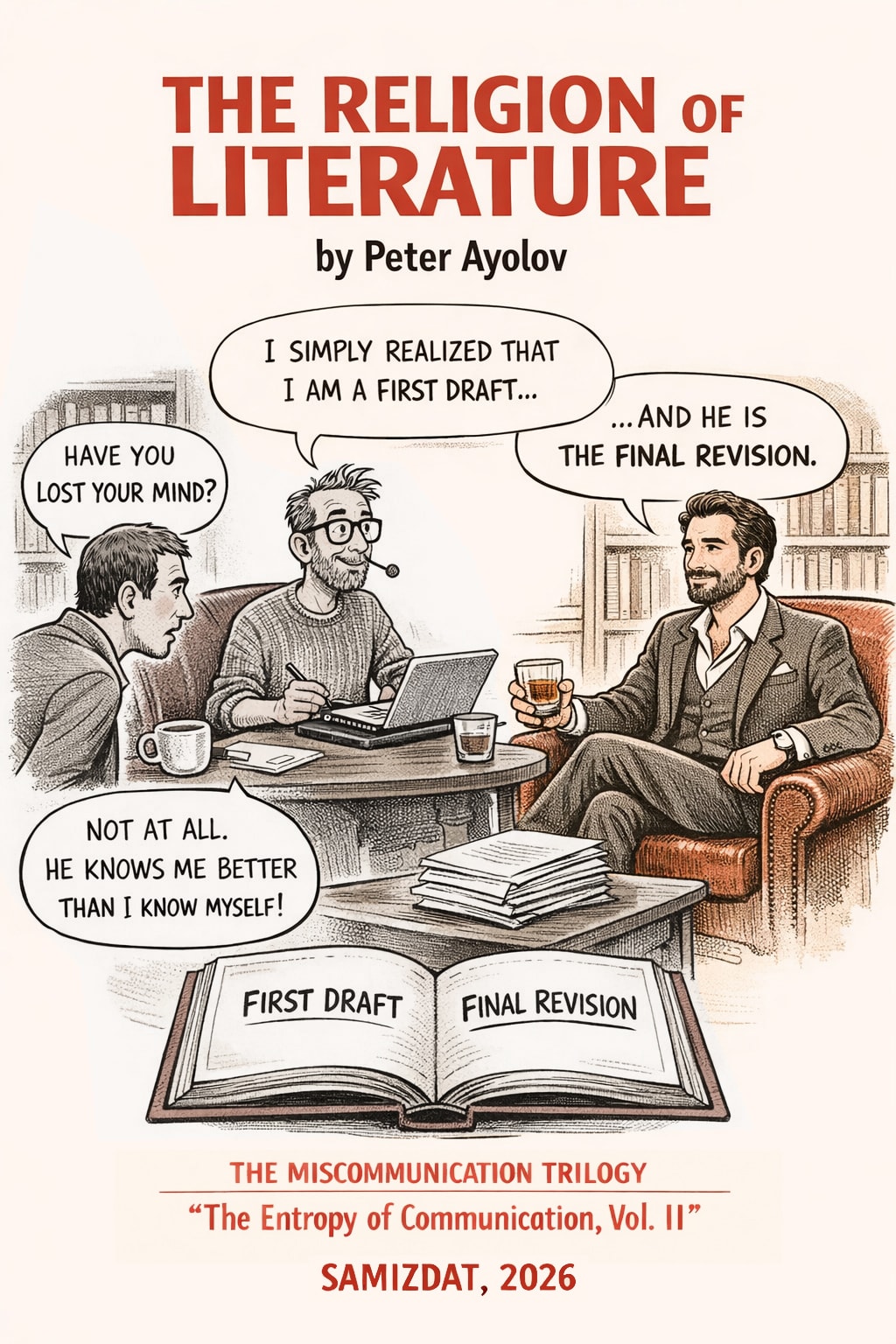
Review-The Religion of Literature
Civilisation as Narrative: Literature, Belief, and the Entropy of Meaning
The Religion of Literature is a wide-ranging and intellectually ambitious work that examines the role of narrative in shaping modern systems of belief, knowledge, and political legitimacy. Positioned within a broader theoretical framework concerned with the instability of communication, the book explores how language structures social reality through interpretative frameworks that increasingly resemble the symbolic authority once exercised by religion. Rather than approaching literature narrowly as artistic writing, the book expands the concept to include the entire textual infrastructure of modern culture: philosophical argument, political theory, historiography, scientific debate, and public discourse. Within this enlarged conception of literature, the book argues, societies construct the stories through which they understand truth, identity, and power.
The central argument unfolds from a provocative premise. Modern societies tend to imagine themselves as rational and secular, having replaced religious authority with empirical knowledge, democratic deliberation, and scientific method. Yet the book suggests that this narrative of intellectual progress conceals a deeper continuity. The interpretative structures through which modern cultures organise knowledge often function in ways strikingly similar to religious systems. They provide frameworks for interpreting experience, create symbolic hierarchies of authority, and establish narratives that define collective identity. In this sense, literature—understood as the total field of textual production—has inherited many of the roles once played by theology. Modern civilisation does not simply communicate through language; it believes through language.
This thesis becomes the organising principle of the book’s diverse intellectual explorations. Rather than presenting a single continuous philosophical argument, the work develops its ideas through a series of interpretative essays engaging with influential thinkers from different disciplines. Each chapter revisits a particular text or theoretical debate and places it within a broader inquiry into the nature of communication, belief, and narrative authority. The result is a kind of intellectual mosaic in which philosophy of language, sociology of knowledge, historiography, political theory, and philosophy of science converge around a shared problem: the instability of meaning in modern communication.
The opening chapters address the philosophical status of religious language, focusing on debates surrounding falsification and belief. Discussions of Alastair McKinnon’s analysis of religious language and Dallas M. High’s reflections on Wittgenstein challenge the familiar criticism that religious statements are meaningless because they cannot be empirically falsified. The book shows that such criticism rests on a narrow conception of language, one derived largely from scientific models of verification. Religious expressions such as ‘God is love’ or ‘I believe in God’ often function not as empirical propositions but as interpretative frameworks guiding how individuals understand experience. In this sense, belief operates less as a testable hypothesis than as an orientation toward reality. By examining the grammar of such expressions, the book reveals that meaning in religious discourse emerges through interpretation rather than through empirical confirmation.
These philosophical reflections serve as an entry point into the book’s broader theme: the interpretative nature of language across multiple domains of knowledge. If religious belief functions through narrative orientation rather than factual demonstration, similar mechanisms appear in other areas of intellectual life. Historical memory, national identity, and scientific explanation all rely on stories that organise events into meaningful patterns. The difference lies not in the presence or absence of narrative but in the institutional contexts that regulate how narratives are accepted, contested, or revised.
One of the most striking sections of the book examines the role of historical narrative in the construction of political identity. A detailed discussion of Afrikaner historical consciousness illustrates how collective memory can merge with religious symbolism to produce a powerful ideological framework. Within this narrative, the experience of the Afrikaner people becomes interpreted as a providential journey comparable to the biblical story of Israel. Historical events such as the Great Trek or the Day of the Covenant acquire sacred significance, reinforcing the belief that national identity reflects divine intention. Through education, political rhetoric, and cultural institutions, this narrative transforms historical interpretation into moral certainty.
The book’s treatment of Afrikaner historiography is not merely a case study in nationalist mythmaking. It also illustrates a general principle about the politics of memory: historical narratives rarely function as neutral descriptions of the past. Instead, they organise selective events into stories that legitimise present political arrangements. By linking religious symbolism with national identity, such narratives transform historical memory into an ideological resource. The analysis demonstrates how language itself becomes a terrain of political struggle, where competing groups attempt to define the meaning of history.
This theme becomes even more explicit in the chapters examining the politics of historical erasure. Drawing on the intellectual legacy of Steve Biko and the Black Consciousness movement, the book shows how colonial and apartheid narratives attempted to deny the historical agency of black South Africans. Official histories portrayed African societies as passive objects of European expansion, thereby legitimising systems of political domination. In response, Black Consciousness thinkers argued that reclaiming historical memory was an essential step toward political liberation. Rewriting history was not simply an academic exercise; it was an act of cultural resistance that restored the dignity and agency of oppressed communities.
The book’s exploration of scientific knowledge provides another dimension to its analysis of narrative authority. Discussions of Karl Popper, Thomas Kuhn, and Imre Lakatos examine how debates about falsification and scientific method reveal the interpretative character of scientific reasoning. Classical views of science portrayed knowledge as a gradual accumulation of verified truths. Yet twentieth-century philosophy of science increasingly challenged this picture. Popper argued that scientific theories can never be conclusively verified but must remain vulnerable to refutation. Kuhn emphasised the role of paradigms that structure scientific research during periods of “normal science.” Lakatos proposed a synthesis in which scientific development occurs through competing research programmes that evolve over time.
By examining these debates, the book demonstrates that even scientific knowledge develops through narratives about reality rather than through purely mechanical procedures of verification. Experiments do not simply confirm or falsify theories; their significance depends on the theoretical frameworks through which they are interpreted. Historical case studies from early quantum physics illustrate how theories may continue to develop even while containing internal inconsistencies. Scientific progress emerges not from the immediate elimination of flawed ideas but from the gradual replacement of one explanatory narrative by another more powerful one.
The discussion of quantum theory provides one of the most vivid illustrations of this dynamic. The development of atomic theory around the work of Niels Bohr shows how a research programme can produce significant empirical predictions despite resting on conceptual assumptions that contradict established physical laws. Rather than abandoning the theory immediately, scientists continued refining its models until a more comprehensive framework eventually emerged. The history of the neutrino hypothesis in beta-decay research demonstrates a similar pattern. An experimental anomaly that once appeared to threaten fundamental conservation laws was later reinterpreted as evidence supporting a new theoretical understanding of particle interactions. In both cases the meaning of experimental results changed as theoretical narratives evolved.
If science illustrates the interpretative flexibility of knowledge, the book’s sociological chapters reveal how social pressures shape public discourse itself. Drawing on Timur Kuran’s concept of preference falsification, the book examines how individuals often conceal their genuine beliefs in order to conform to perceived social expectations. Public opinion may therefore diverge dramatically from private conviction. Individuals express support for ideas they privately reject because dissent carries reputational or political costs. The result is a form of collective illusion in which societies appear to agree about issues that many individuals actually question.
The implications of this phenomenon are profound. Political systems respond primarily to publicly expressed opinions rather than to hidden beliefs. When preference falsification becomes widespread, institutions may appear stable even though underlying dissatisfaction remains strong. Historical examples show how regimes sustained by apparent consensus can collapse suddenly once individuals begin expressing their true preferences openly. Public discourse, therefore, functions less as a transparent reflection of collective belief than as a theatre of strategic communication in which individuals manage their reputations.
The book’s analysis of preference falsification also raises important questions about the nature of democratic institutions. Democracies pride themselves on protecting freedom of expression, yet social pressures often limit what individuals feel comfortable saying. The right to speak does not eliminate the reputational consequences of dissent. In this sense, the gap between private belief and public expression may persist even in societies that formally guarantee free speech. Political life becomes a delicate negotiation between sincerity and conformity.
Throughout these discussions the book returns repeatedly to the metaphor suggested by its title. Literature, understood as the textual culture of modern civilisation, functions as a new form of religion. This metaphor does not imply that literature demands supernatural faith. Rather, it emphasises the interpretative authority exercised by narratives. Religious traditions historically organised the moral and cosmological imagination of communities. Today similar functions are performed by secular narratives embedded in political discourse, academic theory, historical memory, and scientific explanation. These narratives provide frameworks through which societies interpret reality, yet they remain historically contingent and subject to reinterpretation.
The final chapters reflect on the implications of this narrative condition. As modern societies produce ever greater volumes of information, the frameworks that organise meaning become increasingly contested. Communication enters a state of entropy in which competing narratives multiply faster than consensus can stabilise them. Political debates clash with historical interpretations, scientific theories compete with ideological explanations, and public discourse becomes saturated with rhetorical performance. Language continues to structure social reality, yet its authority becomes less stable as interpretative frameworks proliferate.
The Religion of Literature ultimately offers a striking diagnosis of modern intellectual culture. It suggests that the crisis of communication facing contemporary societies does not arise simply from misinformation or technological change. Instead, it reflects a deeper condition: the proliferation of narratives through which individuals attempt to organise meaning. Every narrative provides orientation, yet every narrative also introduces new possibilities for disagreement. Communication becomes a field of interpretative struggle rather than a transparent channel of information.
As a work of intellectual synthesis, the book succeeds in drawing connections across disciplines that are rarely discussed together. Philosophy of language, sociology of knowledge, political theory, and philosophy of science are woven into a coherent exploration of narrative authority. The result is not merely a commentary on individual thinkers but a broader reflection on how modern societies construct meaning through language.
By treating literature as the symbolic infrastructure of civilisation, the book invites readers to reconsider the foundations of communication itself. Words do not simply describe the world; they create the stories through which societies attempt to understand it. In an age saturated with information, recognising the narrative character of knowledge may be the first step toward understanding why communication so often generates misunderstanding.
About the Creator
Peter Ayolov
Peter Ayolov’s key contribution to media theory is the development of the "Propaganda 2.0" or the "manufacture of dissent" model, which he details in his 2024 book, The Economic Policy of Online Media: Manufacture of Dissent.
Keep reading
More stories from Peter Ayolov and writers in BookClub and other communities.
POLITICAL LANGUAGE OF ENTROPY, THE MISCOMMUNICATION TRILOGY, “The Entropy of Communication, Vol. II”, part 4
Review-Political Language of Entropy Civilisation and the Entropy of Speech: When Political Language Wears Out Political Language of Entropy is a sweeping intellectual exploration of the gradual degradation of political discourse in modern societies. Situated within a broader theoretical framework that examines communication as a dynamic system subject to historical and structural pressures, the book offers a profound reflection on how language—once the principal medium through which societies organised power, law, and collective identity—can slowly lose its capacity to stabilise meaning. The central thesis is disarmingly simple yet philosophically rich: political language, like any complex symbolic system, is vulnerable to entropy. As words circulate through institutions, media networks, ideological conflicts, and digital platforms, they accumulate layers of competing interpretations until their semantic coherence begins to dissolve.
By Peter Ayolovabout 10 hours ago in BookClub




Comments
There are no comments for this story
Be the first to respond and start the conversation.