
The Mystery of Skeleton Lake
High in the Indian Himalayas lies Roopkund, a remote glacial lake where hundreds of ancient skeletons have puzzled scientists and historians for decades.

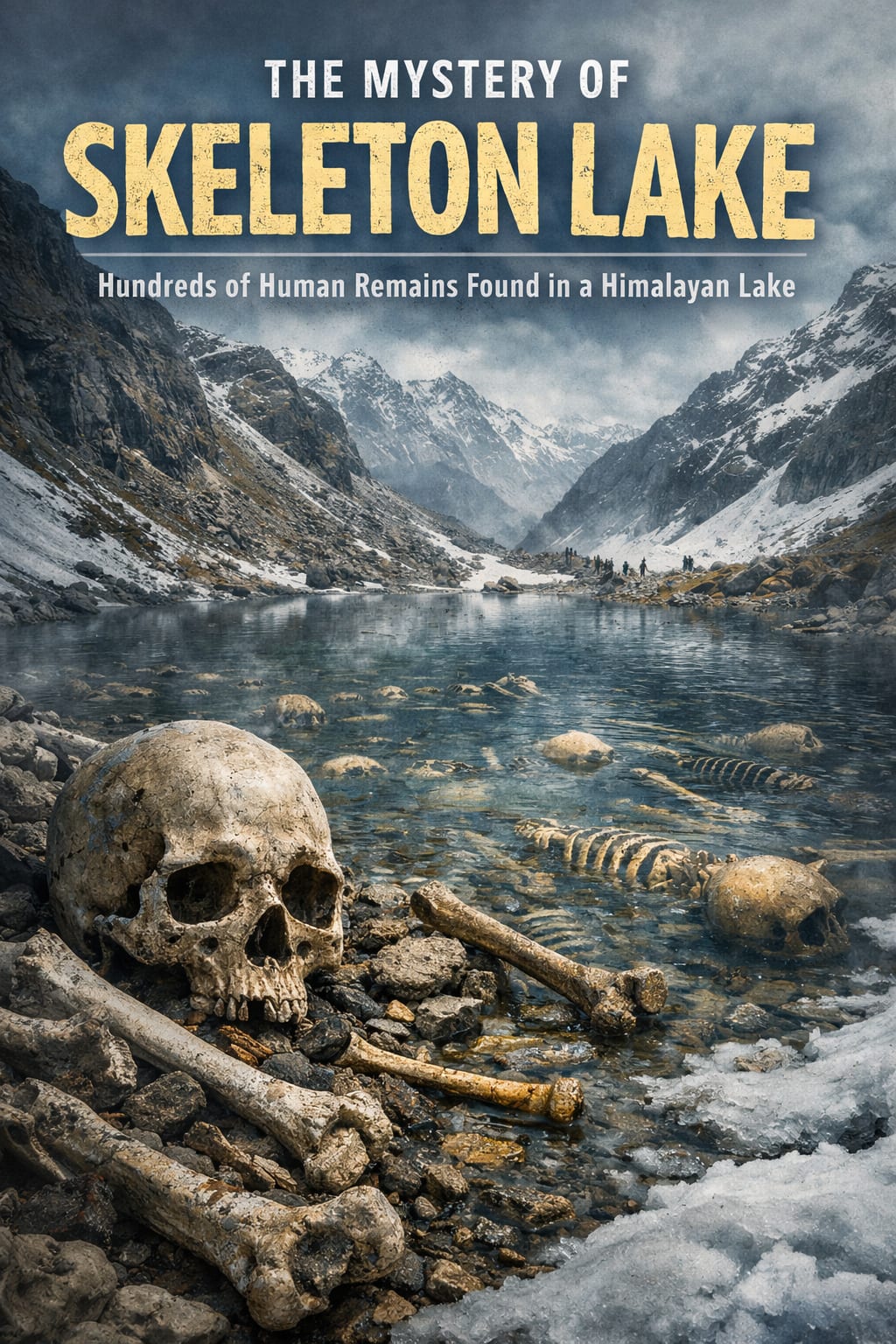
Hidden high in the rugged mountains of the Indian Himalayas lies one of the world’s most mysterious archaeological sites: Roopkund Lake, widely known as “Skeleton Lake.” Nestled at an altitude of more than 5,000 meters (16,500 feet), this small glacial lake becomes visible only when the snow melts during warmer months. What makes the site extraordinary is the eerie discovery of hundreds of human skeletons scattered around and inside the lake, creating one of the greatest unsolved mysteries in the Himalayas.
The lake is located in the Indian state of Uttarakhand, deep within the Himalayan mountain range. Due to heavy snow and difficult terrain, the area remains inaccessible for most of the year. However, during summer when the ice melts, the lake reveals a haunting sight: skulls, bones, and partially preserved human remains lying along its edges and beneath the shallow water.
The mystery of Skeleton Lake first gained global attention in 1942 when a forest ranger named Hari Kishan Madhwal reportedly stumbled upon the site. Initially, the discovery caused alarm among British colonial authorities, who suspected the remains might belong to soldiers from the Japanese army during World War II. However, further investigations quickly ruled out this possibility when scientists realized the skeletons were far older.
Over the decades, researchers conducted numerous studies on the bones to determine their origin. Early scientific examinations suggested that the skeletons dated back roughly 1,000 years. Yet, the real breakthrough came when modern DNA analysis and radiocarbon dating were carried out by international research teams, including scientists from Harvard University and Max Planck Institute for the Science of Human History.
Their findings, published in 2019, revealed something even more surprising: the skeletons did not all belong to the same group or time period. Instead, they represented people from different regions and centuries. Some remains dated back to around the 9th century, while others appeared to be from as late as the 19th century. Even more astonishing was the discovery that several individuals had genetic ancestry linked to populations from the Mediterranean region, possibly from areas like Greece or Crete, raising new questions about how such people ended up in this remote Himalayan location.
One of the earliest and most widely accepted theories suggests that many of the skeletons belonged to a group of pilgrims who were traveling through the mountains. The lake lies along a route used during the famous Nanda Devi Raj Jat, a religious pilgrimage held roughly every 12 years in honor of the Hindu goddess Nanda Devi. According to local legends, a large group of pilgrims may have been caught in a sudden and deadly hailstorm.
This theory gained support from physical evidence found on the skulls. Scientists discovered that several skulls showed round fractures consistent with blunt-force trauma from above. Researchers believe unusually large hailstones—possibly as big as cricket balls—could have caused fatal head injuries. In the open alpine terrain, with no shelter available, such a storm could have easily killed dozens or even hundreds of people.
Despite these explanations, many questions remain unanswered. Why were people from distant regions, including those with Mediterranean ancestry, present at such a remote site? Were they travelers, traders, explorers, or participants in a pilgrimage? And why did multiple groups appear to die there centuries apart?
Adding to the mystery is the preservation of the remains. Due to the extremely cold temperatures and thin mountain air, many skeletons have remained remarkably well preserved for centuries. Some even retained fragments of clothing, wooden artifacts, and jewelry, offering glimpses into the lives of those who perished.
Today, Roopkund Lake continues to attract trekkers, historians, and scientists from around the world. The site lies along the popular trekking route near Trisul Peak and the sacred mountain Nanda Devi. However, authorities have recently restricted access to protect the fragile environment and preserve the archaeological remains.
The haunting beauty of Skeleton Lake, combined with the tragic story hidden beneath its icy waters, makes it one of the most fascinating historical mysteries on Earth. Even after decades of research, the lake continues to challenge scientists and inspire curiosity. Whether the victims were pilgrims, travelers, or victims of nature’s fury, their silent bones remain a powerful reminder of the unpredictable forces of the Himalayan mountains.
In the end, Skeleton Lake is more than just an archaeological puzzle—it is a chilling window into human history, nature’s power, and the enduring mysteries that still lie hidden in the world’s most remote places.
About the Creator
Irshad Abbasi
Ali ibn Abi Talib (RA) said 📚
“Knowledge is better than wealth, because knowledge protects you, while you have to protect wealth.
Keep reading
More stories from Irshad Abbasi and writers in Earth and other communities.
The World’s Largest Natural Pressure Cooker
Hidden beneath the beautiful landscapes of Yellowstone National Park lies one of the most powerful geological systems on Earth. Famous for its geysers, hot springs, and colorful thermal pools, Yellowstone is not just a national park—it is the surface expression of a gigantic volcanic system known as the Yellowstone Caldera. Because of the immense heat, pressure, and gases trapped beneath the ground, scientists often describe this system as the world’s largest natural pressure cooker.
By Irshad Abbasi about 9 hours ago in Earth
The Door to Hell
In 1971, Soviet geologists accidentally opened a portal to an underground natural gas cavern in Turkmenistan's desert, and to prevent poisonous gas from spreading, they set it on fire expecting it to burn out in weeks—it's still burning today.
By The Curious Writerabout a minute ago in Earth
Oil Market is Volatile Again: What It Means for Global Energy and Traders
Global energy markets are once again at the center of attention after the United States introduced a temporary waiver allowing the purchase of certain Russian oil shipments that were already stranded at sea. The move has sparked intense discussions across financial markets, energy sectors, and geopolitical circles.
By Daniel Reid4 days ago in Earth



Comments
There are no comments for this story
Be the first to respond and start the conversation.