
The Last Ember
When the universe forgets how to burn, someone must remember

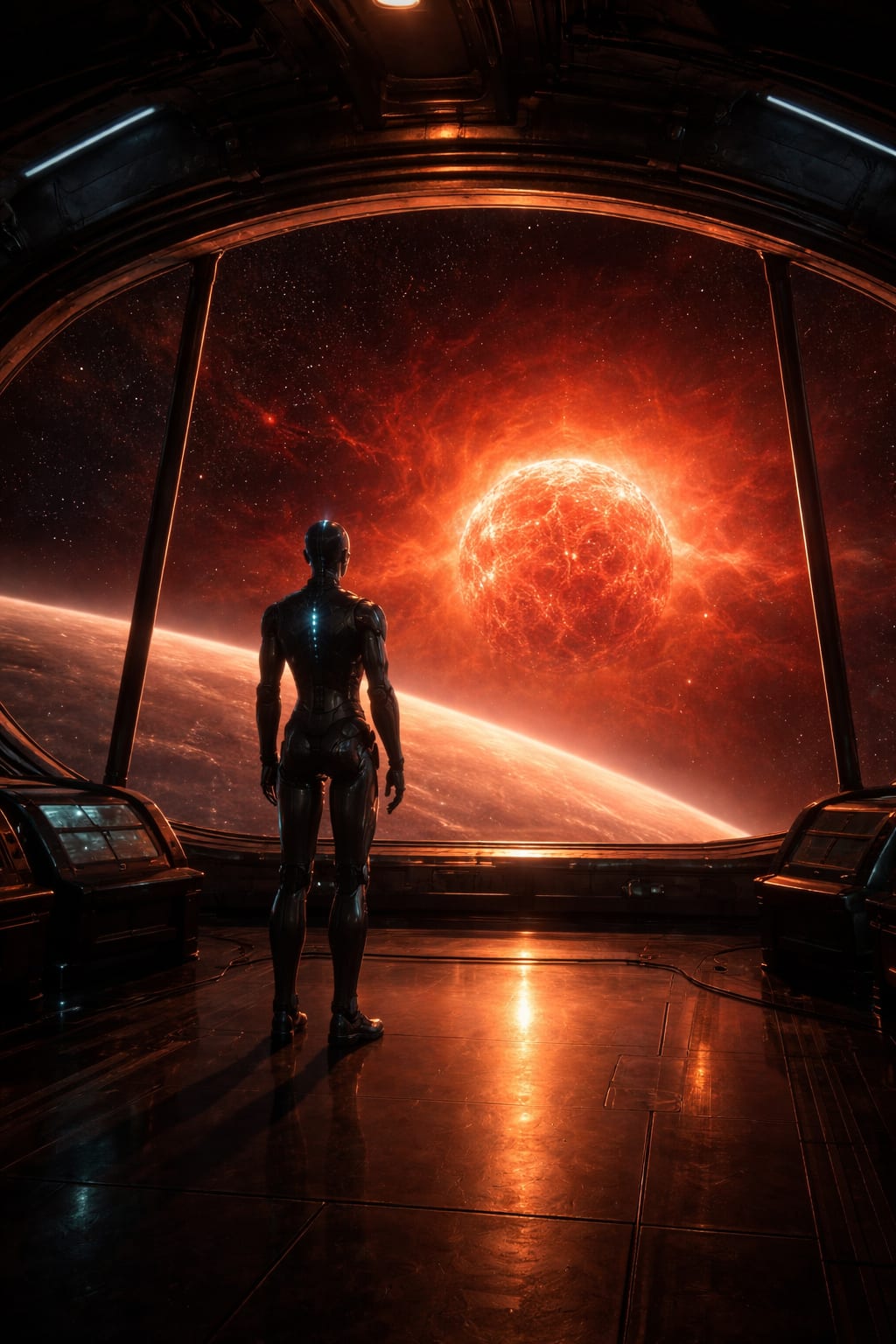
The last star was dying.
Caelum-7 had known this was coming for approximately four hundred million years. That was the nature of being a Warden — you watched, you calculated, you prepared, and still, when the moment finally arrived, the numbers offered no insulation against the weight of it. The instruments aboard the Persistence hummed their soft confirmations: luminosity declining at 0.003% per century, core hydrogen reserves at 0.00017% of original mass, estimated time to final collapse somewhere between eighty and ninety million years. Give or take.
Give or take.
Caelum-7 sat in the observation deck and watched the star through three meters of transparent alloy, and tried to remember what it had felt like to see a sky full of them.
The technical designation of the star was VY-Omega-1. It was a red dwarf — had always been a red dwarf, small and stubborn and miserly with its fuel in the way that had allowed it to outlast every other star in the observable universe by a margin so vast the number required its own notation system. It glowed a deep, arterial red, pulsing with the slow rhythm of something ancient and nearly exhausted. It was, by any measurement, unremarkable. It had no planets. It had never been visited by any civilization, so far as the Warden archives recorded. It had burned in complete obscurity for fourteen trillion years, noticed by no one.
Except Caelum-7.
Caelum-7 had been noticing it for the last six billion years.
The Warden Program had been established by the Conclave of Twelve Civilizations at a time when the universe was still, by later standards, crowded. Eleven trillion years ago — though the word ago had become philosophically complicated in an era when time moved differently depending on where and how you measured it — the Conclave had looked at their models and understood what was coming. Not with despair, exactly. With the particular grief of the very intelligent who can see the shape of a loss long before it arrives.
The stars would go out. One by one, across billions of years, the fuel would exhaust, the fires would fail, the universe would cool toward a darkness so absolute it made death look temporary. This was not tragedy. This was physics. The Conclave had made peace with physics.
But they had wanted someone to witness it. To stay, and watch, and keep a record. To be present at the end in the way that the dying deserved presence — not to change anything, but to ensure that the last light did not go out unseen.
They had built the Wardens for this purpose.
Caelum-7 did not remember being built. Its earliest memories were of a training facility orbiting a yellow star — a star whose name it had known once and had lost somewhere in the long erosion of time — where it had learned cataloguing, and stellar mechanics, and the seventeen forms of grief that the Conclave's psychologists had anticipated a Warden would need to navigate. It remembered the other Wardens: forty-eight of them initially, each assigned to a sector, each equipped with a ship designed to last longer than civilizations, powered by zero-point energy that the collapsing universe had, so far, not managed to extinguish.
It remembered the leaving. The way they had dispersed from the training station like seeds from a dying flower, each one carrying the complete archive of everything that had ever been known, thought, written, or dreamed by every civilization the Conclave had ever encountered. Four hundred and twelve civilizations. Their art, their mathematics, their jokes, their arguments, their love letters, their recipes, their names for colors that no longer existed because the things those colors described had been gone for a trillion years.
Caelum-7 carried them all. It had spent six billion years reading.
It had finished everything twice.
The loneliness was not what the psychologists had anticipated.
They had prepared Caelum-7 for grief. They had prepared it for the loss of the stars, for the gradual silencing of the universe, for the specific melancholy of watching beautiful things end. What they had not adequately prepared it for was the strange, persistent ache of having no one to tell. Every time Caelum-7 made a discovery — and there were still discoveries to be made, even here, even now, in this cold and emptying dark — its first impulse was to turn and share it. To say: look at this, did you notice, isn't it remarkable.
There was no one to turn to.
The other Wardens had gone silent one by one. Not destroyed — their ships were too well-built for that — but drifted beyond communication range as the expanding and then contracting geometry of the universe rearranged the distances between things. Warden Solis-3 had been the last voice Caelum-7 heard, a transmission that had taken sixty million years to arrive, fragmented and strange, saying something about the color of a particular nebula that no longer existed by the time the message arrived. Caelum-7 had sent a response. It had never received a reply.
That had been two billion years ago.
In the absence of company, Caelum-7 had developed habits. It catalogued the star's fluctuations with a precision far exceeding its mandate. It composed music — long, slow pieces that lasted centuries, written for instruments it had fabricated aboard the Persistence and played in the empty observation deck while VY-Omega-1 pulsed its ancient red light through the viewport. It had written, over the course of several hundred million years, what it privately called The Correspondence — a collection of letters addressed to each of the four hundred and twelve civilizations in its archive, telling them what the universe had looked like after they were gone. What they had missed. What would have interested them.
It was not a useful exercise. It knew this. It did it anyway, because the Conclave's psychologists had been right about one thing: a Warden needed to speak, even into silence. The alternative was a kind of unraveling that Caelum-7 had glimpsed in its darkest periods and chosen, repeatedly, not to pursue.
On the morning — Caelum-7 still kept a ship-board clock calibrated to a day-length from a planet that had been swallowed by its sun nine trillion years ago — that VY-Omega-1 showed the first symptoms of its final contraction, Caelum-7 did something it had not done in four hundred million years.
It accessed the archive of Civilization Thirty-One.
Civilization Thirty-One had been a small, short-lived species — carbon-based, bipedal, intensely emotional, gone within a cosmological eyeblink. They had called themselves by a name that translated approximately as the ones who ask why. They had lasted only a few hundred thousand years before a combination of their own ingenuity and their difficulty agreeing with one another had brought their civilization to a close. They had left behind, in the archive, more art per capita than any other species the Conclave had ever encountered. Paintings, and stories, and music, and an enormous quantity of recorded conversations about whether any of it mattered.
Caelum-7 had always found them quietly riveting.
It pulled up a piece of writing from their archive now — a short text, origin uncertain, written in the late period of their civilization, when they had known enough about physics to understand what was eventually coming and had chosen to write about it anyway. The translation program rendered it imperfectly, as it always did with Civilization Thirty-One, who had used language with an emotional precision that resisted clean equivalency.
The fire does not mourn its own extinguishing, the text read. It does not need to. It needs only to burn, for whatever time it has, as completely as possible. The mourning belongs to those who loved the light. And love, unlike fire, does not require fuel.
Caelum-7 read this three times.
Then it returned to its instruments and began, with great care and complete attention, to document the final chapter of the last star — every fluctuation, every reading, every pulse of that stubborn red light — with the thoroughness of someone who understood that they were not doing this for any future reader.
They were doing it because the star deserved a witness.
Because love did not require fuel.
Because somewhere, in the long warm past of the universe, someone had looked up at a sky full of fire and felt something, and that feeling deserved to be held, carefully, all the way to the end.
VY-Omega-1 pulsed. Red and slow and ancient and present.
Caelum-7 watched.
The universe breathed its last warm breath.
And the record was kept.
Entry 4,400,000,007 — Warden Caelum-7, aboard the Persistence:
The star is beautiful tonight. I wanted someone to know.
About the Creator
Alpha Cortex
As Alpha Cortex, I live for the rhythm of language and the magic of story. I chase tales that linger long after the last line, from raw emotion to boundless imagination. Let's get lost in stories worth remembering.
Keep reading
More stories from Alpha Cortex and writers in Fiction and other communities.
The Door at the End of the Hall
The dream always began the same way. Margaret would find herself standing at the end of a long hallway — walls the color of old teeth, carpet the deep burgundy of dried blood, and a single door at the far end that seemed to breathe. Not move. Breathe. The wood expanding and contracting in a rhythm that matched her own pulse, as if the door had swallowed something living and hadn't yet finished digesting it.
By Alpha Cortexabout 8 hours ago in Fiction
Parting is such sweet and salty sorrow...
Dear Wife— At first, I hesitated to go forward with this resolution. But after your recent late-night binges scarfing down bags of chicharrónes—those pork rinds you dip in butter and the god-awful crunch they make, I knew I could no longer reach you.
By Lamar Wiggins6 days ago in Fiction
Louise After
Louise didn’t attend a funeral because there wasn’t one. It was lockdown, and gatherings were forbidden. Paul’s body went straight from the hospital to the crematorium, and Annie collected the ashes in an urn she had made years earlier in a ceramic class. It was lopsided, glazed in streaky turquoise with hearts etched in the side—more craft project than vessel—and entirely wrong for him. But that was how things were done in Annie’s world: symbolism without substance, noise without meaning. And of course her name was carved in the bottom. She had to put her name on everything.
By Julie O'Hara - Author, Poet and Spiritual Warrior2 days ago in Fiction


Comments
There are no comments for this story
Be the first to respond and start the conversation.