
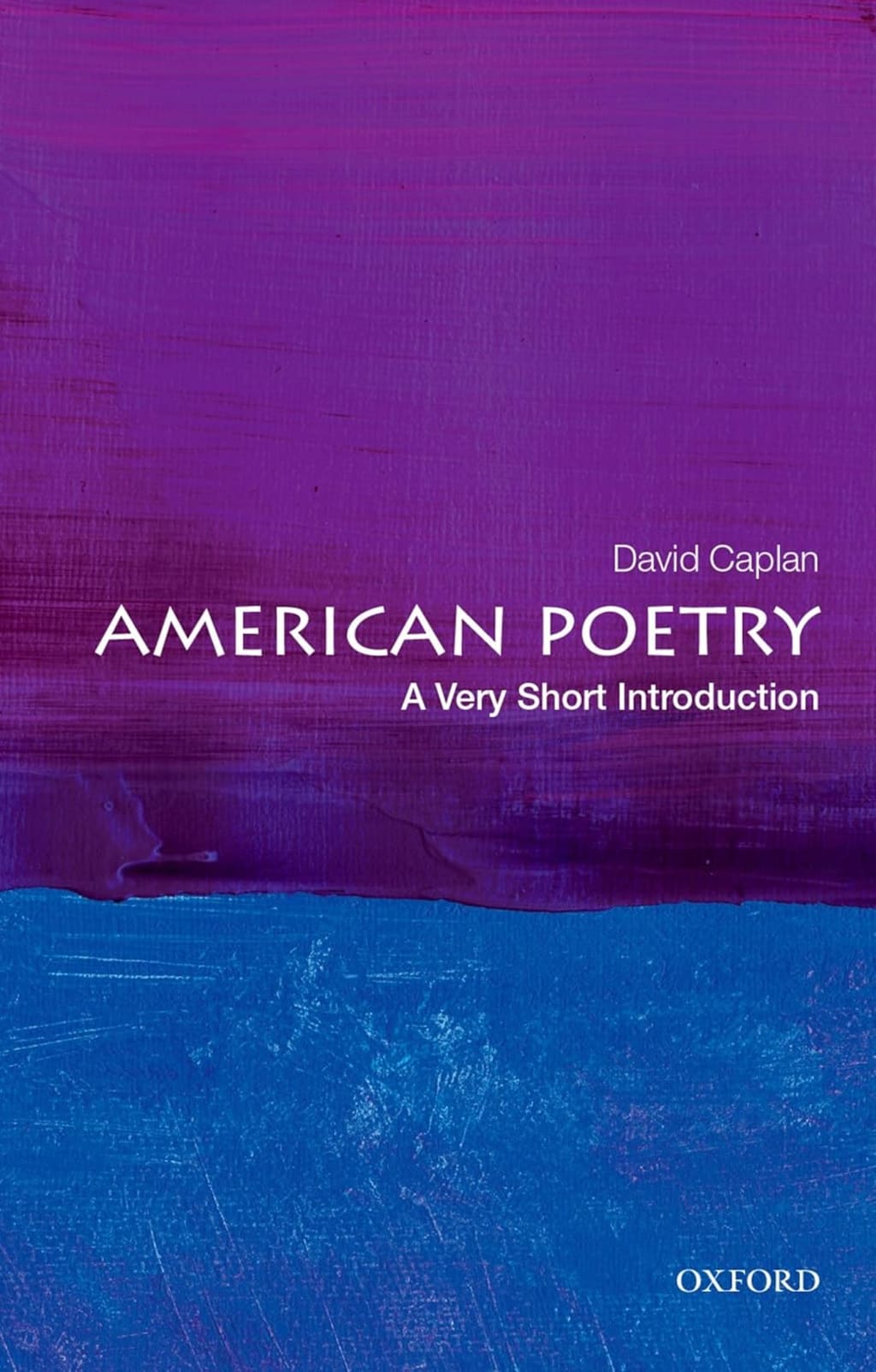
Book Review: "American Poetry: A Very Short Introduction" by David Caplan
5/5 - one of the best in the series so far...
Help me, I'm stuck in the Very Short Introduction series and I can't get out!
No really, this is becoming the same problem I had a few years ago when I got my limbs caught in the British Library Crime Classics series and ended up reading almost 100 of those books in perhaps a few months. Now, I've managed to find one on American Poetry, I have to say it is probably one of my favourites so far. I mean The Beats is good, but American Poetry has Phillis Wheatley and Emily Dickinson so it is, by default, better. The writer doesn't only display his knowledge of American Poetic History, he also provides some historical accounts of the people who wrote them, commenting on where they fit into the greater American landscape.
Phillis Wheatley has a tribunal to judge whether it was really her who wrote this brilliantly religious poetry. The panel decides that it virtually could not have been anyone else. A slave has spent sixteen months learning the English language from books, knowing the Bible and reading especially, the most difficult parts in order to understand them better. She then goes on to write poetry in which she uses this imagery, she uses the forms and structures of Alexander Pope (whom she read as well) to communicate her religious and moral ideas. She is thus remembered as one of the first female writers in American History. Personally, I think Wheatley was a prodigy of some kind and nobody recognised it - she perhaps had a naturally very high IQ and it wasn't understood back in that day. Give me a whole lifetime of trying to learn something I could never get close to where she got to in just over a year.
Emily Dickinson is described in an episode of The Simpsons as having gone 'crazy as a loon' (Season 8, Episode 25), (in this clip it's at approximately 56 seconds) but I don't think that is an accurate analysis though it was funny at the time. Emily Dickinson, like Phillis Wheatley, was probably misunderstood by people who were of lesser intellect than she was. The book describes her poetry as being like 'riddles' and so, we can only assume that there was some different plain that she was on in comparison to ourselves. A lot of American Poets have since been influenced by Dickinson as it "refuses to conform to American Literary Traditions" and thus, she is seen as the counter-culture of her day. If we remember that her day was one of convention being the underlying rule, we can start to understand that she was a greatly intelligent figure, probably even more so than her poetic contemporaries.
I loved reading about Eliot and Auden and how the latter moved to America and wrote some of his best poetry. I am personally a fan of Auden's and his poetry has proven to be some of the best on the topics of mortality (of course, you've all read Funeral Blues, but I urge you to read some of his other poems as well). The author makes the point that not all American Poetry is by Americans and even though WB Yeats lived most of his life elsewhere, many people still regard him as an Irish Poet. He talks about Seamus Heaney and Joseph Brodsky when it comes to looking at writing that was done in America that may, or may not, be considered American even though the writers themselves are not.
I love the fact that he goes through the fact that poems read in different accents mean they have different meters. Such as certain poems written in iambic pentameter would not be so if it were read in an accent that was American if it were written in Britain. It is true that though we both share a language, we often struggle to understand each other though we are using the same words. The poetry definitely reflects this as well. Our cultural experiences are different and so, when it comes to language - our culture impacts the way we understand what is going on in the sentence/poem.
I adored this book. It definitely goes through the great ways in which American poetry has come through the history of the country and formed its own thing. We cannot assume it is quite done yet though - there are thousands of budding poets across the water as we move into the future.
About the Creator
Annie Kapur
I am:
🙋🏽♀️ Annie
📚 Avid Reader
📝 Reviewer and Commentator
🎓 Post-Grad Millennial (M.A)
***
I have:
📖 300K+ reads on Vocal
🫶🏼 Love for reading & research
🦋/X @AnnieWithBooks
***
🏡 UK
Keep reading
More stories from Annie Kapur and writers in Geeks and other communities.
Rereading Review: "Martin Chuzzlewit" by Charles Dickens
Martin Chuzzlewit is one of Dickens' lesser known novels and I'm not going to lie to you but I originally wrote thousands of words for this review before cutting it down. I originally read it (and disliked it) when I was about 20 years' old and I thought that perhaps coming back to it older would make me appreciate the humour more. Spoiler alert: it didn't. I don't like the snide humour of this book, or the attempts at slapstick comedy in atmospheric writing. But I will say that it is satirical and fun and has some of the best examples of writing that the young Dickens had to offer at the time. It may not be in my top five Dickens novels but that's besides the point. Let's take a look at some of my favourite scenes and characters...
By Annie Kapura day ago in Geeks
History of The Three Stooges (Part I: The Beginnings and Columbia Pictures - 1920s-1936)
I have been itching to write about The Three Stooges on Vocal for close to two years, but I couldn't figure out how to do it. I wanted to do it by third Stooge, but that's a bit complicated. I know this much. I was about eight or nine years old when I first saw The Three Stooges. I remember one of my local channels had the Stooges on for hours, and I tried my damnedest to be up for those shorts. I remember that the Family Channel actually had an hour of the Stooges on from 11PM to midnight, and it was the entire library on during that time.
By Clyde E. Dawkins5 days ago in Geeks
My Top 10 Favorite Movie Dragons
#1 - Smaug (from The Hobbit: The Desolation of Smaug) He is fire. He is death. While I am not a huge fan of The Hobbit movie series (I think the movies are extremely slow-paced), I was in awe when I first saw Smaug on-screen. Benedict Cumberbatch did an exceptional job with the motion capture facial expressions and movements, and his voice acting for the wicked wyvern is chilling. Smaug is brought to life in a terrifying way that leaves a lasting impression.
By Madison "Maddy" Newton6 days ago in Geeks


Comments (1)
Thanks for sharing, and I love the Simpsons clip, and Lisa's thoughts on Emily Dickinson