
4,400‑Year‑Old Priest’s Tomb Unearthed in Saqqara
Exceptionally Preserved Burial of High Priest Wahtye Sheds New Light on Old Kingdom Life and Rituals

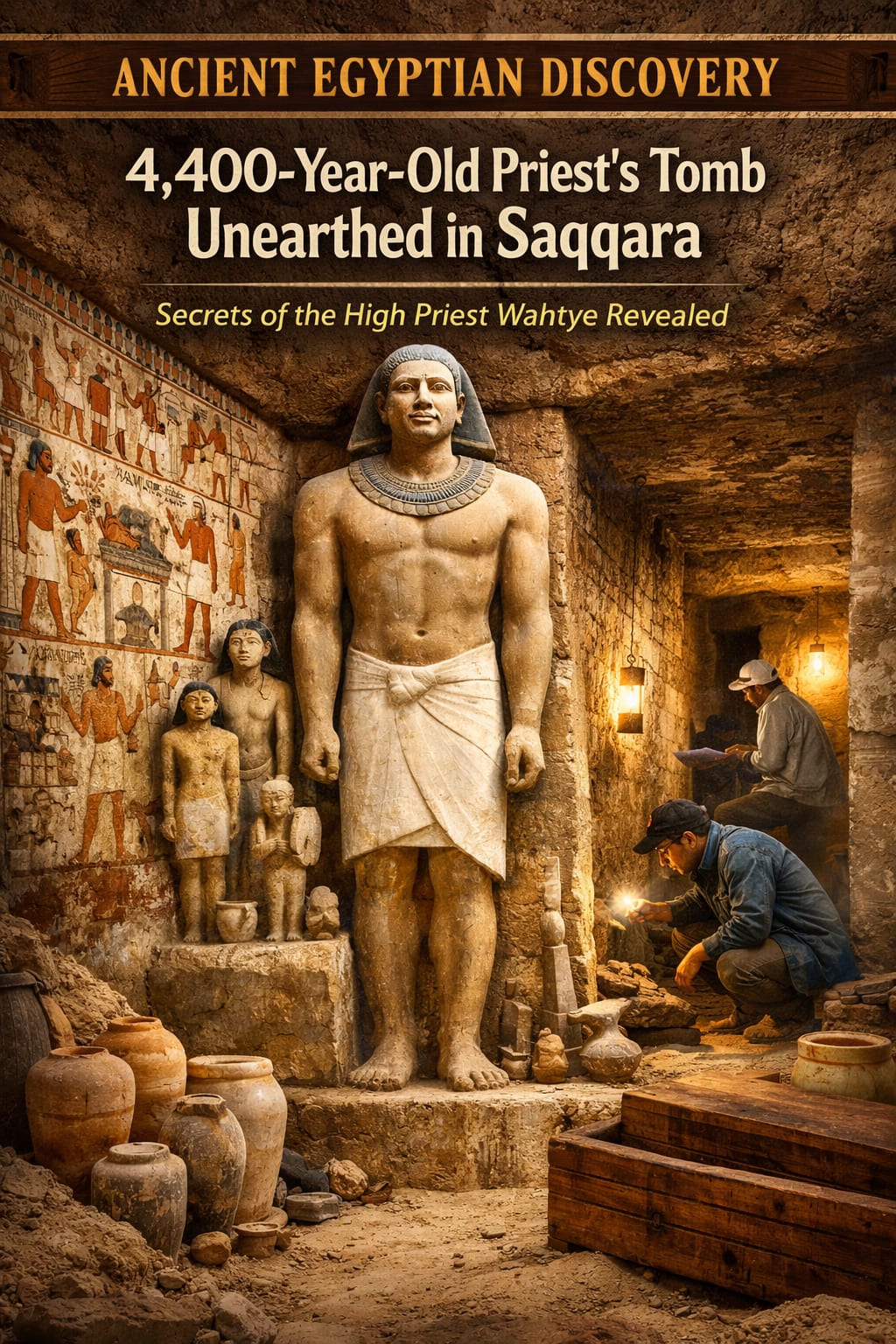
Archaeologists in Egypt have made a remarkable discovery that is captivating historians and Egyptologists around the world: an exceptionally well‑preserved tomb belonging to an ancient priest that dates back approximately 4,400 years. The burial site, found in the vast necropolis of Saqqara just south of Cairo, reveals extraordinary insights into the life and religious beliefs of a high‑ranking official during Egypt’s Old Kingdom period.
The tomb belonged to Wahtye, a senior priest and official who served under King Neferirkare of the Fifth Dynasty, around the mid‑25th century BC. His titles, inscribed in hieroglyphs on the tomb’s entrance, describe him not only as a “royal purification priest” but also as an overseer of sacred estates and inspector of the divine boat, indicating that he held considerable religious and administrative responsibilities within the ancient state.
Located around five meters below the shifting sands of Saqqara, the tomb was discovered by an Egyptian archaeological team led by experts from the country’s Ministry of Antiquities. Despite its great age, the burial chamber was found in an extraordinary state of preservation, with vibrant wall paintings, sculptures, and numerous statues still intact.
Inside the tomb’s main chamber, archaeologists uncovered a richly decorated gallery that measures roughly 10 meters long and 3 meters wide. The walls are adorned with scenes depicting Wahtye’s life, including everyday activities such as hunting, sailing, pottery‑making, and the preparation of offerings. These colorful reliefs also portray the priest alongside members of his family — his wife Weret‑Ptah, his mother Merit Meen, and their children — giving researchers a rare, intimate view of family life and social structure in ancient Egypt.
One of the most striking features of the tomb is the large number of statues that line its walls. There are dozens of figures of varying sizes and forms, each representing Wahtye, his relatives, or symbolic objects intended to provide for him in the afterlife. These niches hold full‑sized statues and smaller carved representations, which were believed to magically sustain the deceased in the world beyond.
The discovery also suggests that ancient Egyptians’ concept of death was deeply spiritual and complex. Rather than seeing death as an end, they viewed it as a transition to another existence. Tombs such as this were designed to ensure that the deceased had all they needed to thrive in the afterlife — from depictions of food production to musical performances — reflecting a belief system grounded in continuity and ritual.
Although the tomb was sealed for millennia, parts of it show signs of ancient flooding and wear over time. Despite this, many of the original details remained remarkably preserved, allowing archaeologists to reconstruct not only the physical layout of the tomb but also aspects of Wahtye’s role in society.
Egypt has been actively promoting such archaeological findings as part of broader efforts to spotlight its rich cultural heritage and revive tourism. Discoveries like this one not only uncover more about ancient Egyptian customs and beliefs but also attract international interest from scholars and travelers alike.
This tomb’s significance lies not only in its age but also in the depth of cultural and historical information it provides. The intricate carvings and colorful paintings serve as a vivid record of life during the Fifth Dynasty, illustrating religious practices, social hierarchies, and artistic achievements that have endured for over four millennia.
In addition to the painted reliefs and statuary, the tomb contained five burial shafts that archaeologists are still investigating. These shafts could yield further artifacts and remains, potentially offering deeper insights into burial practices and family structures among the elite of ancient Egypt.
The name Wahtye itself — meaning “one who is pure” — reflects the priest’s esteemed position in ancient Egyptian society. The discovery of his tomb allows researchers to piece together the complex rituals and beliefs that governed not only how people lived but also how they prepared for eternity.
As excavations continue, the world watches with fascination the unfolding story of a man who lived more than four thousand years ago, whose tomb has now opened a new window into one of history’s most remarkable civilizations.
About the Creator
Irshad Abbasi
Ali ibn Abi Talib (RA) said 📚
“Knowledge is better than wealth, because knowledge protects you, while you have to protect wealth.
Keep reading
More stories from Irshad Abbasi and writers in History and other communities.
Rumours of a Pharaoh’s Curse Spark Panic After Ancient Sarcophagus Unearthed in Egypt
In recent days, a bizarre wave of rumours has swept across Egypt following the unveiling of an ancient stone sarcophagus, purportedly dating back to the time of the pharaohs. The rumours claimed that opening the coffin had unleashed a supernatural disaster or curse upon the country, igniting fear on social media and among local communities. However, experts in archaeology and Egyptology have firmly dismissed these claims as myths rooted in folklore rather than fact.
By Irshad Abbasi about 2 hours ago in History
semen Veritatis:
In a world increasingly driven by personal choices and societal interactions, the essence of responsibility often boils down to one fundamental principle: our actions define our accountability. Whether in our personal lives, professional endeavors, or community involvement, the decisions we make and the behaviors we exhibit have far-reaching consequences. This article explores the profound connection between actions and responsibility, highlighting how the choices we make shape not only our own lives but also the lives of others around us. By understanding this relationship, we can cultivate a greater sense of accountability and intentionally navigate the complexities of our responsibilities.
By Alain juniora day ago in History




Comments
There are no comments for this story
Be the first to respond and start the conversation.