
Who Really Built Rome?
The True Architects Behind an Eternal City

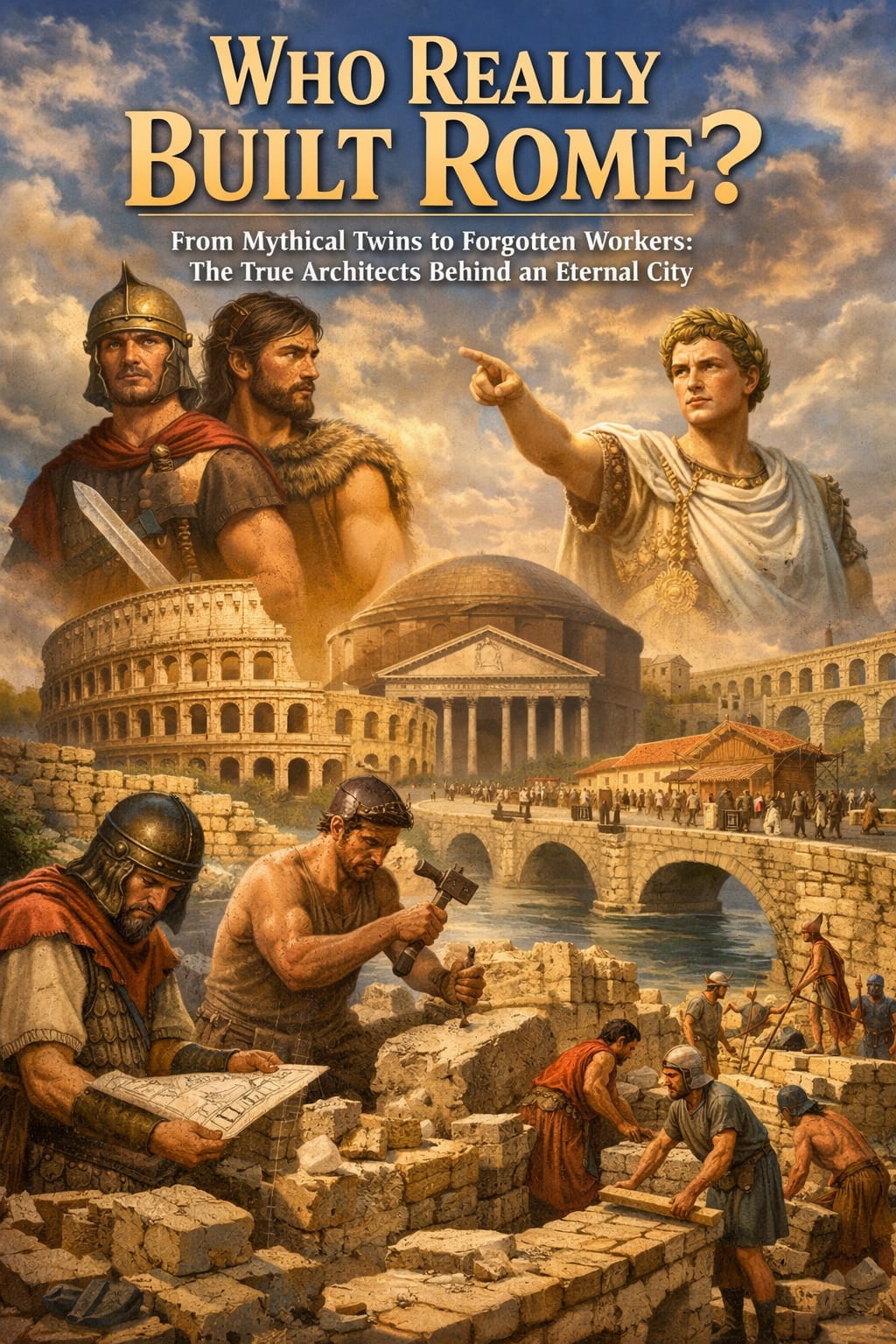
The story of who built Rome is often told through legend, heroism, and imperial glory. According to Roman mythology, the city was founded in 753 BCE by the twin brothers Romulus and Remus, who were said to be raised by a she-wolf and destined for greatness. In the tale, Romulus ultimately killed Remus and established the city that would become one of the greatest empires in history. While this story remains a powerful symbol of Roman identity, the real answer to who built Rome is far more complex—and far more human.
Archaeological evidence suggests that Rome did not emerge overnight from a single act of foundation. Instead, it developed gradually from small settlements scattered across the hills near the Tiber River. Around the 8th century BCE, Latin tribes began to cluster together for protection and trade. Over time, these villages merged, forming a unified community that would evolve into Rome. In this sense, Rome was not “built” by a single person, but by generations of ordinary people whose names are lost to history.
One of the earliest significant influences on Rome’s development came from the Etruscans, a powerful civilization to the north. The Etruscans contributed greatly to Rome’s early architecture, engineering, and urban planning. They introduced innovations such as drainage systems, temples, and public spaces. The famous Cloaca Maxima, one of the world’s earliest sewage systems, is believed to have been constructed under Etruscan influence. Without these advancements, Rome might never have grown into a thriving city.
As Rome transitioned from monarchy to republic, its construction and expansion accelerated. During the era of the Roman Republic, infrastructure projects became central to civic life. Roads, aqueducts, and public buildings were constructed on a massive scale. These were not the work of emperors alone but of thousands of laborers, engineers, and enslaved people. Roman roads, for instance, were carefully engineered to last for centuries, enabling military movement and trade across vast distances.
Later, during the time of the Roman Empire, construction reached unprecedented heights. Emperors like Augustus famously claimed that they “found Rome a city of brick and left it a city of marble.” Monumental structures such as the Colosseum, the Pantheon, and extensive aqueduct systems became symbols of Roman engineering genius. Yet, behind these grand achievements were countless unnamed builders—craftsmen, stonecutters, architects, and slaves—whose labor made such wonders possible.
It is also important to recognize the role of Rome’s diverse population. As the empire expanded, people from different cultures and regions contributed their skills and knowledge. Greek architects influenced design, Egyptian techniques shaped certain construction methods, and local materials from across the empire were used to build its cities. Rome became a melting pot of innovation, where ideas from many civilizations came together to create something extraordinary.
Beyond physical construction, Rome was also “built” in a cultural and political sense. Lawmakers, philosophers, and citizens contributed to systems of governance and law that still influence the modern world. The development of Roman law, republican governance, and urban organization played as much a role in building Rome’s legacy as its physical structures did.
So, who really built Rome? The answer lies not in a single figure or moment, but in a collective effort spanning centuries. Mythology gives us heroes like Romulus, history gives us emperors and engineers, but reality points to a vast network of ordinary people—workers, settlers, and visionaries—who together shaped the Eternal City.
In the end, Rome stands as a testament to human collaboration. Its stones were laid by many hands, its ideas shaped by many minds, and its legacy carried forward by generations. The true builders of Rome were not just kings or legends, but the countless individuals whose combined efforts turned a cluster of villages into one of the most influential civilizations in history.
About the Creator
Irshad Abbasi
Ali ibn Abi Talib (RA) said 📚
“Knowledge is better than wealth, because knowledge protects you, while you have to protect wealth.
Keep reading
More stories from Irshad Abbasi and writers in History and other communities.
Who Lived Through the Ash and Fire?
When the Roman city of Pompeii was buried under volcanic ash and pumice in 79 AD, it seemed as though the entire population had perished. The catastrophic eruption of Mount Vesuvius unleashed a deadly combination of ash clouds, toxic gases, and pyroclastic surges that froze the city in time. Today, Pompeii is often remembered as a place where life abruptly ended—but the truth is more complex. Not everyone died. Some people did survive.
By Irshad Abbasi about 10 hours ago in History
Emperor of Nothing, King of Everything: The Strange Reign of Norton I
In the fall of 1859, in a city still finding its footing at the edge of a restless continent, a man walked into the offices of the San Francisco Bulletin and made a declaration that, by all conventional standards, should have been dismissed outright. He declared himself: “Norton I, Emperor of the United States.” He would later add, with equal authority: “Protector of Mexico.”
By The Iron Lighthouse4 days ago in History
🔥 Edge of Fire: Iran, USA, and Israel Push the World Toward Global War
🔥 Edge of Fire: Iran, USA, and Israel Push the World Toward Global War The world is once again gripped by fear as tensions between Iran, the United States, and Israel erupt into open confrontation. What began as a series of strategic warnings and limited strikes has now evolved into a dangerous and unpredictable conflict. Across the Middle East, explosions, air raid sirens, and military mobilizations are no longer isolated incidents—they are part of a growing crisis that threatens global stability.
By Wings of Time 4 days ago in History
Foraging Appalachia’s Wild Edibles
It's that time of year again and Appalachia offers a remarkable abundance for anyone willing to learn its seasonal gifts and practice careful gathering. Across ridges, holler's, stream-side's, and meadows, edible plants, berries, roots, and fungi appear through every part of year. Knowledge is key and teaches not only what can be eaten, but also how to gather with respect so that these resources remain available far into future.
By Tim Carmichael4 days ago in Feast



Comments
There are no comments for this story
Be the first to respond and start the conversation.