
Beyond the Creepy pasta
5 Startling Realities of Human Endurance and the Great Beyond

1. Introduction: The Lure of the Macabre
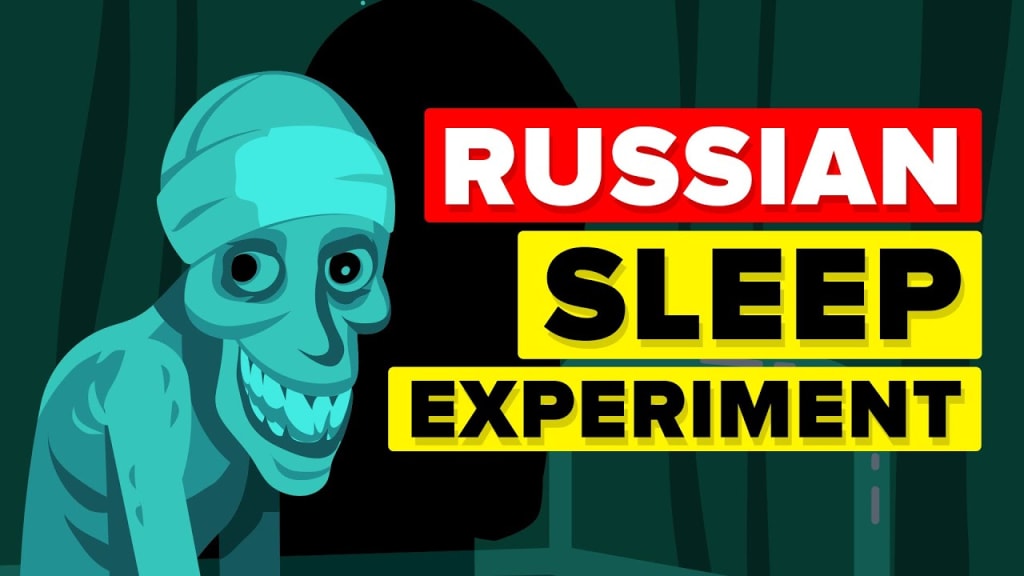
The "Russian Sleep Experiment" remains the most resilient urban legend of the digital age. It depicts a 1940s Soviet research facility where five prisoners, fueled by an experimental stimulant gas, allegedly endured fifteen days of wakefulness, eventually descending into a cannibalistic frenzy. The narrative concludes with subjects eviscerating themselves while pleading for more of the chemical agent, claiming to represent the "madness" inherent in the human soul.
We find these tales compelling because they tap into a primal curiosity regarding the fragility of the human mind and the mystery of the body's final cessation. However, when we strip away the "creepypasta" veneer, the biological reality of human endurance and the transition to death is far more grounded—and in many ways, more unsettling—than any internet myth. By examining forensic realities and empirical data, we can dismantle the fiction and explore the startling truths of our biological limits.
2. Takeaway 1: The "Russian Sleep Experiment" is Purely Fictional (And Anatomically Impossible)
While the legend persists as a "secret" historical document, it is easily identified as a work of catastrophic flash fiction. The narrative’s central conceit—an abdominal cavity emptied of its vital architecture while the host remains conscious and combative—is a biological hallucination that ignores the sheer, violent physics of hypovolemic shock. The story describes subjects who "ripped the skin and muscles from their own chests" and laid their internal organs on the floor "like a piece of art" or "a bunch of textbooks."
In reality, such trauma would result in near-instantaneous death from blood loss. Beyond the anatomical nonsense, the story suffers from glaring internal inconsistencies. As noted in the forensic deconstruction of the tale’s "bad writing":
"The story simply doesn’t make sense at times... In another part, the writer says the oxygen levels indicated the men were alive and the researchers knew that, and then in the next part he says the researchers were not sure if they had all died."
Ultimately, the tale is the product of an internet-era imagination rather than a medical journal or a Soviet bunker.
3. Takeaway 2: The 48-Hour Hard Limit of Military Performance
The myth of a 15-day stimulant gas is a stark contrast to actual military data. While the legend suggests that extreme sleep deprivation produces "super-soldiers" with monstrous strength, the Pentagon’s findings are much grimmer.
Historically, militaries have experimented with chemical wakefulness. In World War II, German forces utilized Pervitin (a methamphetamine), while British and American troops were issued Benzedrine (an amphetamine). Even with these potent chemical aids, soldiers generally only maintained alertness for 24 to 36 hours. According to Pentagon studies, once a human passes the 48-hour mark without rest, they become "pretty much useless." Cognitive erosion leads to critical errors, and the body’s need for "micro-sleeps" becomes an evolutionary imperative that no known gas can override without causing total physiological collapse.
Science does offer real-world parallels to the horror of sleeplessness, but they lack the "zombie" payoff. Morvan’s Syndrome can cause severe delirium and insomnia, yet sufferers enter a dreamlike state rather than a cannibalistic one. Similarly, Fatal Familial Insomnia—a genetic nightmare—eventually leads to death but never to the supernatural endurance seen in fiction.
4. Takeaway 3: Death is Much "Noisier" Than You Expect
Our cultural perception of death is often sanitized, yet the immediate aftermath of clinical death—the cessation of the heart—is a remarkably active and "noisy" biological transition. Biological death is not a silent snuffing of a candle, but an undignified and visceral affair.
As the nervous system fails, the body undergoes several startling changes. The relaxation of the sphincters leads to the expulsion of waste, while the "moans and groans" emitted by the deceased—caused by air escaping the lungs and vibrating the vocal cords—can sound hauntingly like life to the uninitiated.
Other active phenomena include:
Involuntary Twitching: Small muscle contractions that mimic purposeful movement.
Abdominal Gas Buildup: In rare and macabre instances, these gases can lead to "coffin birth," where the pressure of putrefaction forces a fetus from a deceased pregnant woman.
Post-Mortem Erections: Occurring if the body is positioned face-down, allowing blood to pool via gravity.
5. Takeaway 4: The Incredible Longevity of the Human Skeleton
Decomposition is a highly predictable forensic timeline. While the process is grim, it highlights the resilience of the human skeletal structure compared to the rapid liquefaction of soft tissue.
The Stages of Biological Decay:
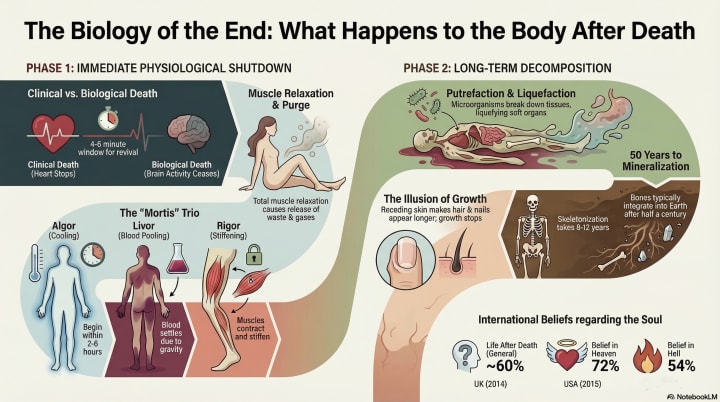
Algor Mortis (The "Death Chill"): The body cools at a steady rate until it matches the ambient temperature.
Livor Mortis: Blood pools in the lower portions of the body, creating dark purple discoloration.
Rigor Mortis: Occurring 2–6 hours after death, the body becomes stiff as calcium floods the muscle cells.
Putrefaction: Microorganisms begin a "carnal feast," liquefying soft tissue. The resulting odor is famously described as "rotten eggs, feces, and a used toilet left out for a month x 1000."
The Forensic Timeline:
Above Ground: A cadaver can be reduced to a liquefied mess by insects and bacteria within a single month.
Buried: In a traditional grave, it takes approximately 8 to 12 years to reach full skeletonization.
Final Absorption: It takes roughly 50 years for the bones themselves to break down and become part of the Earth.
6. Takeaway 5: The "Inner Madness" vs. the Eternal Recurrence
The "Russian Sleep Experiment" concludes with a chilling monologue suggesting that humans harbor an inner madness suppressed only by sleep. This fiction is bolstered by visceral details, such as a subject who "smiled" at a nurse during a surgery performed without anesthetic, or the man who, having torn his own vocal cords, wrote "Keep cutting" on a pad for his surgeons to see.
While 72% of Americans believe in a rewarded afterlife, individual accounts of near-death experiences vary wildly, often skewing toward a "black emptiness" devoid of consciousness. This biological void stands in opposition to philosophical concepts like Nietzsche’s "eternal recurrence"—the idea that we live the same life repeatedly—or the Buddhist "Wheel of Samsara." The legend’s closing quote attempts to bridge this gap between psychological horror and the unknown:
"We are the madness that lurks within you all, begging to be free at every moment in your deepest animal mind. We are what you hide from in your beds every night. We are what you sedate into silence and paralysis when you go to the nocturnal haven where we cannot tread."
7. Conclusion: The Final Reflection
By deconstructing urban legends like the Russian Sleep Experiment, we find that the truth is rarely as sensational as the fiction, yet it remains deeply profound. We are biological machines bound by a 48-hour cognitive wall and an 8-year path to skeletonization. We are "noisy" organisms that moan as we expire and liquefy when we are done.
We are often more comfortable with the "madness" of fiction than the messy, carnal reality of our own end. Are we terrified of these myths because they are true, or because we hope that even in madness and death, some part of our consciousness refuses to be silenced?
About the Creator
HearthMen
#fiction #thrillier #stories #tragedy #suspense #lifereality
The Elevator That Takes You Somewhere Else
It was nearly midnight when Clara finally finished her work. The office building was silent, the hum of computers long gone, leaving only the faint buzz of fluorescent lights. She gathered her bag, rubbed her tired eyes, and headed toward the elevator.
By Salman Writes5 days ago in Horror
Microsoft's Purposeful Marketing Deception About AI's Ability To Beat Physicians In Diagnosis
When you look at the world of scientific research... If you are not careful... You will be fooled into believing things that are not actually supported by the data.
By Dr. Cody Dakota Wooten, DFM, DHM, DAS (hc)8 days ago in Longevity



Comments
There are no comments for this story
Be the first to respond and start the conversation.