
Kuwait Says Drones Struck Airport’s Radar System
Unmanned Drones Hit Kuwait International Airport Radar, Raising Regional Security Concerns”

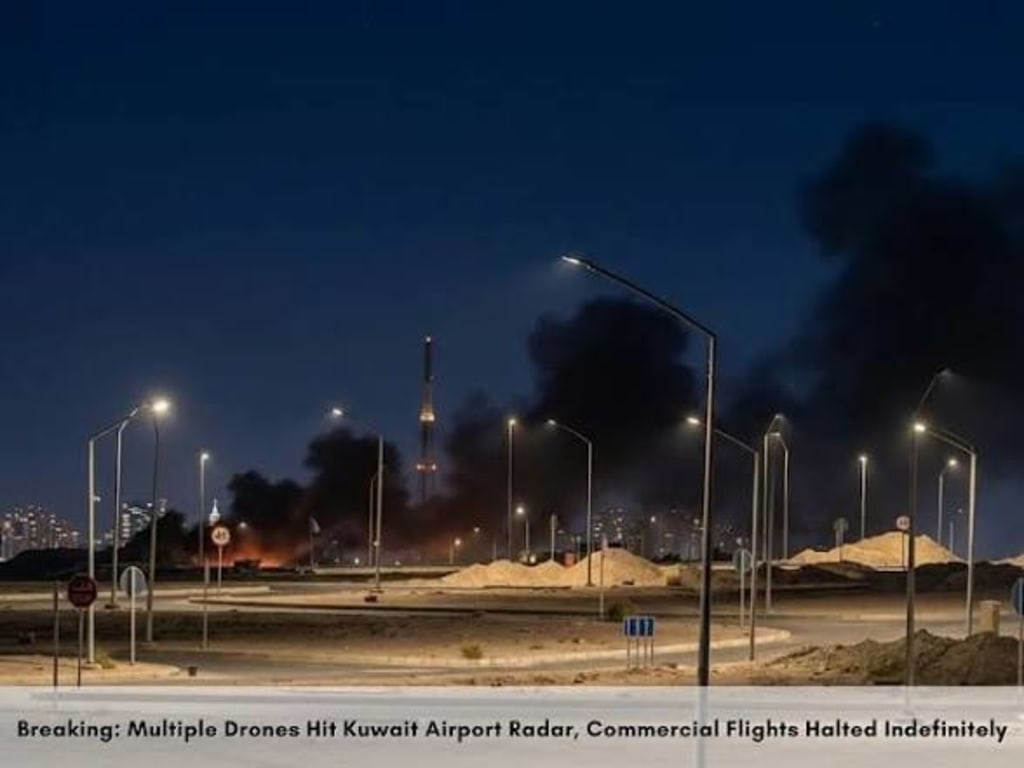
Drone attack damages key air traffic infrastructure as regional tensions escalate
In a significant development on Day 16 of the Middle East crisis, Kuwait’s Public Authority for Civil Aviation confirmed that multiple unmanned aerial vehicles (UAVs) struck the radar system at Kuwait International Airport late Saturday evening, causing damage to critical air traffic control infrastructure but — crucially — resulting in no reported human casualties.
The strike — part of a wider pattern of drone and missile activity across the Gulf in recent weeks — represents an escalation of hostilities that have complicated life in one of the world’s most strategically important regions.
Details of the Attack
According to the civil aviation authority’s statement released on Sunday, several drones approached Kuwait International Airport — one of the busiest hubs in the Gulf — and struck its radar infrastructure, a core component used to monitor and guide aircraft movements. Kuwaiti officials said the incident activated emergency safety procedures put in place earlier in the crisis, and all civil aviation operations were managed according to established protocols.
Spokesperson Abdullah Al‑Rajhi reiterated that no injuries were reported, and authorities are continuing to assess the full extent of the damage. The airport’s runway and passenger terminals were not specifically reported as hit in this latest incident, but the radar damage poses serious challenges for maintaining normal flight operations.
The Kuwaiti military separately confirmed that its air‑defense systems engaged “hostile missile and drone attacks” in connection with the incident, with explosions heard in Kuwait City likely due to interception operations rather than direct strikes on the capital itself.
Regional Context: Escalating Drone Activity
The drone attack on Kuwait’s civil aviation infrastructure comes amid broader regional tensions linked to the ongoing war between the United States and Israel on one side and Iran on the other. Since late February, Iran has launched numerous drone and missile strikes targeting U.S. military installations and allied positions across the Middle East, triggering retaliatory actions and heightened alert levels in nearby countries.
Kuwait — while a smaller Gulf state — finds itself geographically and politically close to major military players. It hosts significant foreign military logistics facilities and serves as a waypoint for regional commerce, making it vulnerable to spillover effects from the conflict. Previous drone and missile activity in and around Kuwait has included attacks on fuel storage and logistic hubs, as well as U.S. bases in the country.
Even before this latest radar strike, Kuwait had experienced direct hits from Iranian drones earlier in the conflict, including strikes that damaged infrastructure and forced temporary closures or operational restrictions.
Impact on Air Travel and Safety
The radar systems at airports are essential for air traffic control, enabling controllers to track and guide aircraft both on the ground and in the skies. Damage to such systems can temporarily disrupt commercial flights, force diversions, or require temporary reliance on backup systems with limited capacity.
Travel analysts and airline officials have warned that the Gulf region’s escalating security risks already heightened passenger anxiety and complicated scheduling, particularly as neighboring hubs — such as Doha, Bahrain, and the United Arab Emirates — have faced their own disruptions.
Kuwait International Airport serves not only domestic and regional flyers but also millions of international passengers annually. Any prolonged downtime of radar systems could significantly affect global flight routes connecting Asia, Europe and Africa via the Gulf. Airlines may need to adjust operations, re‑route flights, or temporarily rely on backup facilities while the damage is repaired.
Government and Security Response
In their official statements, Kuwaiti authorities underscored that existing emergency plans and civil aviation safety measures were activated immediately following the attack. These protocols, introduced early in the regional crisis, aim to ensure passenger and crew safety, maintain airspace order, and mitigate risks to civilian infrastructure.
Kuwait’s defense leadership also emphasized that its integrated air‑defense network — coordinating radar systems, interceptor units and allied support — successfully responded to hostile aerial threats in the region. The military’s statement suggested that sounds heard by residents in Kuwait City likely came from interception efforts against incoming drones or missiles yet to be publicly detailed.
Officials have not publicly identified the party responsible for the drones that hit the radar system, and as of Sunday, no group had claimed responsibility. Given the complex web of alliances and hostilities in the Middle East, attribution remains sensitive and could carry diplomatic implications if officially confirmed. However, the strike is consistent with the pattern of Iranian‑linked UAV activities reported across the Gulf, often in retaliation against foreign military targets.
Look Ahead
As the Middle East crisis continues to unfold, the security of critical transport infrastructure — particularly airports — remains a priority for governments, airline operators, and international aviation agencies. Remaining civilian travel, defense collaborations and emergency preparedness will shape the next chapter of regional resilience and response.
About the Creator
Fiaz Ahmed
I am Fiaz Ahmed. I am a passionate writer. I love covering trending topics and breaking news. With a sharp eye for what’s happening around the world, and crafts timely and engaging stories that keep readers informed and updated.
Keep reading
More stories from Fiaz Ahmed and writers in The Swamp and other communities.
Russia Is Supplying Iran With Shahed Drones, Zelenskiy Says
Ukrainian president alleges Moscow is equipping Tehran with drones now used against U.S. and Israeli targets In a recent interview with CNN, Ukrainian President Volodymyr Zelenskiy made a striking allegation: he claims that Russia has supplied Iran with Iranian‑designed Shahed drones, which Tehran has since used in attacks on United States and Israeli targets in the Middle East. Zelenskiy described this transfer as a “100 percent fact”, asserting that the drones being used against U.S. bases are Russian‑made variants of Iranian Shaheds — a development that has broad implications for global security and regional conflict dynamics. What Zelenskiy Said and the Context During the broadcast interview, Zelenskiy emphasized that the drones Iran is employing in recent strikes on U.S. and allied positions have origins tied back to Moscow. He urged Western audiences to recognize this as a clear example of the deepening military cooperation between Russia and Iran, arguing that Moscow’s support for Tehran extends beyond diplomatic rhetoric into material transfers of military systems. Although detailed evidence has not been publicly presented, Zelenskiy stated confidently that the presence of Russian‑made Shahed drones in the Iranian arsenal is a verified fact, not speculation. His comments come amid escalating tensions in the Middle East — including a widening conflict involving Israel, Iran, and Western forces, in which drone strikes have played a prominent role. What Are Shahed Drones? Shahed drones are a family of Iranian unmanned aerial vehicles (UAVs) and loitering munitions developed by Shahed Aviation Industries, an Iranian aerospace company associated with the Islamic Revolutionary Guard Corps. These drones — particularly the Shahed‑136 model — are designed to fly long distances and detonate on contact, making them effective low‑cost “kamikaze” weapons. Originally deployed by Iran in regional conflicts, the Shahed series gained significant global attention during the 2022 Russian invasion of Ukraine, when Russian forces used them to target Ukrainian cities and infrastructure. Russia also developed its own local production lines for variants — often designated as Geran drones — based on Iranian designs. The Allegations and Why They Matter Zelenskiy’s accusations suggest a reversal of roles in the military supply chain: instead of merely receiving Iranian drones, Russia now allegedly provides them — or at least their production — back to Iran for its own military use. That is particularly significant given that the drones have been deployed in attacks beyond the Ukraine battlefield, including in the Middle East against U.S. and Israeli targets. If confirmed, this would mark a new phase of military collaboration between Russia and Iran, reinforcing concerns among U.S. and NATO officials about coordinated efforts to challenge Western military assets and influence in multiple theatres simultaneously. It could also complicate diplomatic efforts to stabilize conflict zones where both Tehran and Moscow have strategic interests. Regional Impacts and Broader Security Concerns The alleged transfer comes at a time of heightened conflict in the Middle East. Recent strikes on Iranian infrastructure by Israeli forces and subsequent Iranian retaliatory drone and missile attacks have drawn in the United States and raised fears of a wider regional war. In this environment, weapons technology transfers between major state actors could intensify existing tensions and trigger further escalation. U.S. and allied officials have previously expressed concern about the proliferation of Shahed drones and their derivatives. Although these drones are relatively inexpensive — often costing tens of thousands of dollars apiece compared with millions for advanced missiles — their effectiveness and ease of deployment make them attractive tools for asymmetrical warfare. In Ukraine, similar drones have been a persistent threat for years. Ukrainian forces have endured waves of Shahed and Russian variants, prompting Kyiv to develop advanced counter‑drone systems, including electronic warfare and interceptor drones, to defend cities and military targets. The widespread use of such drones in Ukraine has also made Kyiv a source of expertise for countries now facing Shahed strikes in the Middle East. Diplomatic Ripples and Political Fallout Zelenskiy’s claims arrive as Ukraine seeks broader international cooperation against Iranian drone attacks, offering its experience and technology in return for financial and military support. Kyiv has dispatched expert teams to the Middle East to assist in assessing defenses and bolstering anti‑drone capabilities — a move that underscores the interconnected nature of modern conflicts. At the same time, Iran has warned that Ukraine could become a target in retaliation for its support of U.S. and Israeli defenses. Iranian officials have used strong language to criticize Ukraine’s growing cooperation with its adversaries, suggesting geopolitical tensions could expand beyond the current theatres of war. Uncertainties and What Comes Next While Ukraine’s president insists on the validity of the claims regarding Russian supplies to Iran, independent verification remains limited in the public domain. The geopolitical stakes — involving Russia, Iran, the United States and Israel — are high, and each actor has incentives to shape the narrative in ways that support its strategic goals. What is clear is that drones like the Shahed continue to reshape modern warfare, offering both tactical flexibility and strategic headaches for nations contending with asymmetric threats and multifront conflicts.
By Fiaz Ahmed 2 days ago in The Swamp
The Forsyth House Fire
Since 1851, Forsyth House has stood on the corner of Union Street and Gordon Street in the heart of Glasgow. Its iconic, or was... because on Sunday 8th of March, 2026, a fire broke out in a small, seemingly un-named shop in the building and tore all that history down. As I write, the rubble is still unsettled and the street is still blocked off. Central Station is quiet on the upper level, and around 30 small businesses have quite literally gone up in smoke.
By S. A. Crawford4 days ago in The Swamp
Shadow Home Secretary Chris Philp Leads Charge on Starmer's Iran War Stance.
The Iran War has to be one of the most dangerous and unnecessary wars this century so far. Trump has changed the narrative of why he and his partner in crime, Netanyahu, attacked Iran. First, it was to liberate the Iranian people. Then Iran's support for Hezbollah, Hamas, the Houthis, etc. Then it's Iran enriching uranium and its ballistic missile programme. Since the war began, the Ayatollah Khamenei has been assassinated along with top military commanders. His son is now the new Ayatollah. A girl's school has been bombed, with 100 or so schoolgirls sent to Allah. Iran's infrastructure has been hit hard, as has its military and government. If they bombed the Founder of the Islamic Republic's mausoleum, Ayatollah Khomeini, it wouldn't surprise me. It seems the Americans and Israelis are hitting anything and everything across Iran. Similar to the levelling of Gaza by the IDF. Hundreds of Iranians have been killed and injured, civilian and military alike.
By Nicholas Bishop6 days ago in The Swamp
The Solitude of The Chupacabra
Many say that the Chupacabra is a rather recent and modern tale, a mangy coyote or rabied dog. Some point out that it’s just twisted evolution. But very few know the true backstory of the shapeshifter that led to the bloodsucking legend. And perhaps once you will come to know and understand more, you might “forget” a few cattle out to wander.
By Oneg In The Arctic3 days ago in Fiction




Comments (1)
isreal is the bone of contention