
Brazil Desalination Market Size & Summary
Rising Demand for Sustainable Water Solutions Fuels Brazil’s Desalination Growth

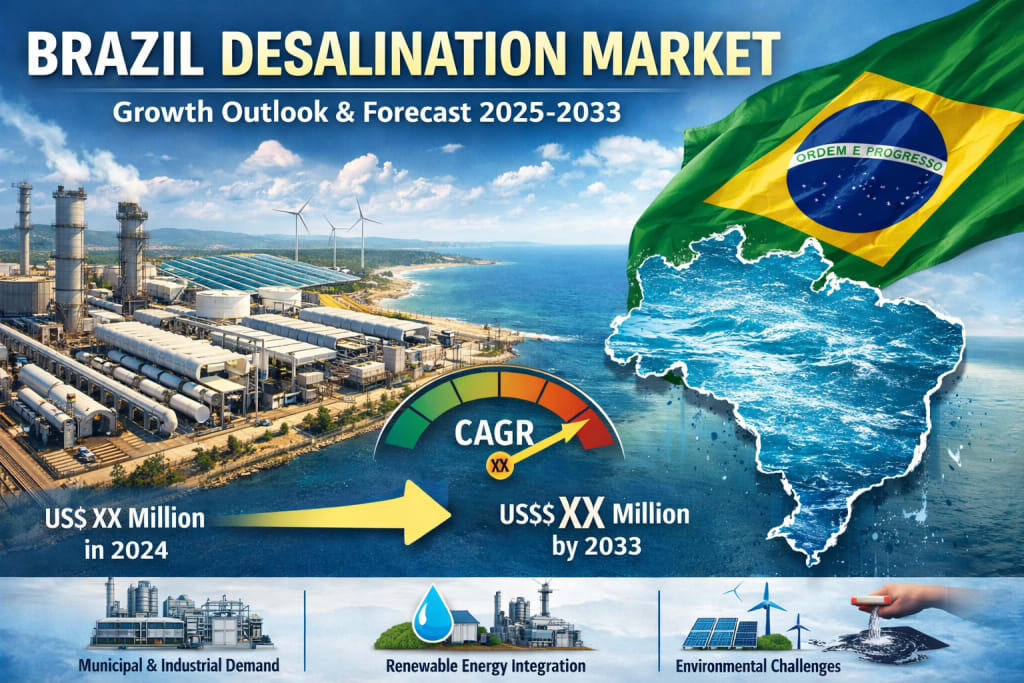
The Brazil desalination market is steadily emerging as a crucial component of the country’s long-term water security strategy. As climate variability intensifies and urbanization accelerates, the demand for reliable, clean water sources is increasing across municipal and industrial sectors. According to Renub Research, the Brazil desalination market is expected to reach US$ xx Million by 2033, growing from US$ XX Million in 2024, at a CAGR of xx% during 2025–2033.
With growing pressure on freshwater resources and increasing industrial water consumption, desalination technologies are becoming an essential solution, particularly in coastal and drought-prone regions. Brazil, despite its vast freshwater reserves, faces regional imbalances in water distribution, making desalination an increasingly viable and strategic option.
Brazil Desalination Market Outlook
Overview
The Brazil desalination market plays a pivotal role in addressing the country’s uneven water distribution and growing demand for potable and industrial water. While Brazil is globally recognized for its abundant freshwater resources, certain regions—especially the Northeast—face recurring droughts and water shortages.
Desalination is gaining traction as a sustainable and dependable alternative, helping municipalities and industries mitigate water scarcity risks. The adoption of advanced technologies such as reverse osmosis (RO), multi-stage flash (MSF), and multi-effect distillation (MED) is enhancing efficiency and reducing operational costs.
The market is supported by a combination of government initiatives, technological advancements, and increasing awareness of water conservation. Furthermore, public-private partnerships are encouraging investments in desalination infrastructure, boosting the sector’s growth potential.
Projected Growth
Between 2025 and 2033, the Brazil desalination market is expected to experience steady expansion. This growth is driven by increasing investments in water infrastructure, rising industrial demand, and the urgent need to secure reliable water supplies.
Reverse osmosis technology is anticipated to dominate the market due to its cost-effectiveness and energy efficiency compared to traditional thermal desalination methods. Additionally, the integration of renewable energy sources such as solar and wind power into desalination systems is expected to further improve sustainability and reduce operational expenses.
Key Growth Drivers in the Brazil Desalination Market
Technological Advancements
Innovations in desalination technologies are significantly transforming the market landscape. Reverse osmosis systems have become more efficient, with improved membrane technology enabling higher water recovery rates and lower energy consumption.
Thermal technologies such as MSF and MED are also evolving, offering enhanced performance and reduced environmental impact. Hybrid desalination systems, combining multiple technologies, are gaining attention for their ability to optimize efficiency and reduce costs.
These advancements are making desalination more accessible and economically viable for a broader range of applications.
Increasing Water Scarcity
Water scarcity is a growing concern in several regions of Brazil, particularly in semi-arid areas. Climate change, irregular rainfall patterns, and over-extraction of groundwater are exacerbating the problem.
Desalination provides a reliable solution by converting seawater and brackish water into potable water, ensuring a consistent supply even during drought conditions. This reliability is a key factor driving adoption across municipalities and industries.
Government Support and Regulations
The Brazilian government is actively supporting the development of desalination projects through policy initiatives, funding programs, and regulatory frameworks.
Efforts to modernize water infrastructure and improve water management practices are encouraging the adoption of advanced desalination technologies. Additionally, environmental regulations are pushing companies to adopt sustainable solutions, further boosting demand for energy-efficient desalination systems.
Industrial Demand for High-Quality Water
Industries such as power generation, mining, oil and gas, and manufacturing require large volumes of high-quality water for their operations. In regions where freshwater availability is limited, desalinated water offers a dependable alternative.
As Brazil continues to expand its industrial base, the demand for desalinated water is expected to rise, contributing significantly to market growth.
Challenges in the Brazil Desalination Market
High Initial Capital Investment
One of the primary challenges facing the desalination market is the high cost of setting up desalination plants. Large-scale facilities require substantial investment in infrastructure, technology, and maintenance.
This can be a barrier for smaller municipalities and private enterprises, limiting widespread adoption.
Energy Consumption
Desalination processes, particularly thermal methods like MSF and MED, are energy-intensive. High energy consumption increases operational costs, making desalinated water more expensive than conventional water sources.
Although advancements in energy efficiency and renewable integration are helping address this issue, it remains a significant challenge for the industry.
Environmental Concerns
The environmental impact of desalination, particularly the disposal of brine, is a critical concern. Improper management of byproducts can harm marine ecosystems and biodiversity.
Regulatory scrutiny and public opposition to environmental risks may slow down project approvals and increase compliance costs.
Market Segmentation Analysis
By Technology
Reverse Osmosis (RO):
Reverse osmosis is the most widely used desalination technology in Brazil due to its efficiency, scalability, and relatively lower energy requirements. It is extensively used for both seawater and brackish water desalination.
Multi-Stage Flash (MSF) Distillation:
MSF is a thermal desalination process commonly used in large-scale plants. While effective, it is energy-intensive and generally used in regions where energy costs are less restrictive.
Multi-Effect Distillation (MED):
MED offers improved energy efficiency compared to MSF and is gaining popularity in applications requiring thermal desalination.
Others:
Emerging technologies such as electrodialysis and hybrid systems are contributing to innovation in the market, focusing on reducing costs and improving sustainability.
By Application
Municipal:
Municipal applications represent a significant share of the market, as desalination is increasingly used to supply drinking water in water-scarce regions.
Industrial:
Industries rely on desalinated water for various processes, including cooling, steam generation, and chemical processing. This segment is expected to witness strong growth due to increasing industrialization.
Others:
Additional applications include agriculture, aquaculture, and specialized uses requiring high-quality water.
By Water Source
Seawater:
Seawater desalination dominates the market, particularly in coastal areas where access to seawater is abundant.
Brackish Water:
Brackish water desalination is a cost-effective alternative, especially in inland regions with saline groundwater.
River Water:
Although less common, river water desalination is used in specific scenarios where water quality requires advanced treatment.
Others:
Includes non-traditional sources such as lakes and ponds.
By Region
Northeast Brazil:
This region experiences the highest levels of water scarcity, making it a key area for desalination projects. Government initiatives are particularly focused here to address chronic drought conditions.
Southeast Brazil:
As the country’s economic hub, the Southeast has a growing demand for water driven by urbanization and industrial activities. Desalination is being explored as a supplementary water source.
South Brazil:
While relatively water-rich, the region is witnessing increased demand due to agricultural and industrial expansion.
North Brazil:
Despite abundant freshwater resources, desalination is used for niche applications in remote or industrial areas.
Porter’s Five Forces Analysis
Supplier Power – Moderate:
Suppliers of specialized equipment such as membranes and filtration systems hold some leverage due to technological complexity.
Buyer Power – Moderate:
Buyers have options, but high switching costs and specialized requirements limit their bargaining power.
Competitive Rivalry – High:
The market is highly competitive, with both global and regional players investing in innovation and expansion.
Threat of Substitutes – Moderate:
Alternative solutions like water recycling and groundwater extraction exist but are not always sufficient or sustainable.
Threat of New Entrants – Moderate:
High capital and technological barriers limit entry, although innovation may create opportunities for new players.
SWOT Analysis
Strengths
Advanced technologies improving efficiency and reducing costs
Strong government support for water infrastructure
Weaknesses
High capital and operational costs
Environmental concerns related to brine disposal
Opportunities
Integration of renewable energy with desalination systems
Expansion in drought-prone regions
Threats
Fluctuating energy prices
Regulatory challenges and environmental opposition
Competitive Landscape
The Brazil desalination market is characterized by the presence of several global and regional players focusing on technological innovation and strategic partnerships.
Leading companies include Acciona, Dow, Evoqua Water Technologies, Siemens AG, DuPont, Doosan Enerbility, Toray Industries, Inc., and Xylem. These companies are investing heavily in research and development to enhance membrane efficiency, reduce energy consumption, and develop sustainable desalination solutions.
Competitive strategies include mergers and acquisitions, collaborations with government agencies, and the development of customized solutions tailored to regional needs.
Key Strategic Recommendations
Investment in Energy-Efficient Technologies
Companies should prioritize the development of low-energy desalination systems to reduce operational costs and improve market competitiveness.
Expansion of Hybrid Systems
Hybrid desalination technologies combining RO, MSF, and MED can offer improved efficiency and flexibility, making them attractive for diverse applications.
Focus on Sustainability
Adopting environmentally friendly practices, including responsible brine management and the use of renewable energy, is essential for long-term growth and regulatory compliance.
Final Thoughts
The Brazil desalination market is entering a transformative phase, driven by the urgent need for sustainable water solutions and supported by technological innovation and government initiatives. While challenges such as high costs and environmental concerns persist, ongoing advancements in energy efficiency and system design are expected to mitigate these issues.
As water scarcity becomes an increasingly critical issue, desalination will play a vital role in ensuring water security for Brazil’s growing population and expanding industrial base. With strong growth prospects and increasing investments, the market is poised to become a cornerstone of the country’s water management strategy through 2033.
About the Creator
Australia Drones Market Growth, Forecast, and Strategic Insights 2034
Drones, also known as unmanned aerial vehicles (UAVs), are rapidly transforming industries across Australia. Once primarily used for military applications, drones are now widely deployed in sectors such as agriculture, construction, logistics, mining, and emergency response. Their ability to capture real-time aerial data, monitor large areas efficiently, and perform tasks in hazardous environments has made them a valuable technological tool for businesses and government agencies alike.
By Rashi Sharma5 days ago in Trader
Mexico Generative AI Market Outlook 2026-2034 | Projected to Hit USD 1,035.5 Million
Mexico Generative AI Market Size, Growth, and Forecast (2026–2034) The Mexico generative AI market is gaining strong momentum as organizations increasingly adopt advanced technologies to improve efficiency and innovation. The market reached a value of USD 257.5 Million in 2025 and is expected to grow to USD 1,035.5 Million by 2034, expanding at a CAGR of 16.22% during 2026–2034.
By Kim Soo hyunabout 10 hours ago in Trader



Comments
There are no comments for this story
Be the first to respond and start the conversation.