
S&P 500 Index: Insights into the U.S. Stock Market and Investment Strategies
Understand the S&P 500 Index, its market performance, and investment opportunities. Learn how U.S. market stability can be balanced with high-growth sectors and emerging market potential.


Introduction
The S&P 500 Index is one of the most followed equity indices worldwide, tracking 500 of the largest publicly traded U.S. companies. It serves as a key benchmark for investors aiming to gain exposure to large-cap stocks across diverse sectors, including technology, healthcare, financials, and consumer goods.
While the S&P 500 reflects the health of mature U.S. markets, investors increasingly compare its performance with emerging market opportunities. High-growth technology companies and innovative digital platforms from emerging economies complement the stability of the S&P 500, offering broader portfolio diversification.
Overview of the S&P 500
The S&P 500 is a market-cap-weighted index, meaning companies with larger market capitalization have a stronger influence on the index’s movements. It is widely regarded as a barometer of U.S. economic performance and investor confidence.
Mutual funds, ETFs, and index funds that track the S&P 500 make it accessible to a broad range of investors, from retail to institutional, offering diversified exposure to major U.S. companies.
Key Components
Technology Sector
Technology is the largest contributor to the S&P 500’s performance, driven by companies that lead in innovation, software, and hardware. The sector often sets the pace for overall market trends and long-term growth within the index.
Emerging market tech platforms show similar growth potential by adopting scalable business models that address local consumer needs, offering an interesting contrast for investors balancing U.S. stability with high-growth opportunities.
Healthcare and Financials
Healthcare and financial services provide defensive qualities to the S&P 500. Healthcare companies innovate in pharmaceuticals and services, while financial institutions benefit from lending, asset management, and payment systems, supporting consistent performance across economic cycles.
Consumer and Industrial Sectors
Consumer discretionary, staples, and industrial companies add further diversification. By including these sectors, the S&P 500 reflects broad economic activity, reducing dependency on a single industry for returns.
Investment Perspective
Investing in the S&P 500 offers long-term growth, dividend income, and portfolio diversification. It serves as a benchmark for evaluating performance and for constructing balanced investment strategies.
Many investors complement S&P 500 holdings with high-growth sectors or emerging market opportunities to increase potential returns while maintaining exposure to the stability of U.S. markets.
Market Trends and Analysis
Recent S&P 500 trends reflect the impact of consumer behavior, technological adoption, and macroeconomic factors like interest rates and inflation. Technology often leads market rallies, while defensive sectors cushion against volatility.
Investors looking at emerging markets may notice higher growth potential but also higher risk, including regulatory and infrastructure uncertainties. Combining investments across mature and emerging markets can provide a balanced risk-reward profile.
Challenges and Risks
While the S&P 500 represents mature market stability, it is not immune to economic slowdowns, geopolitical tensions, or market volatility. Investors need to monitor sector exposure, market cycles, and global trends to manage potential risks.
Balancing U.S. index exposure with emerging market opportunities and tech-driven growth companies allows investors to diversify while pursuing higher returns.
Conclusion
The S&P 500 Index continues to be a cornerstone of U.S. investment portfolios, offering exposure to large-cap companies and a diversified mix of sectors. Its stability makes it a reliable benchmark, while investors can complement it with high-growth opportunities in technology and emerging markets to maximize long-term returns. The S&P 500 Index continues to be a cornerstone of U.S. investment portfolios, offering exposure to large-cap companies and a diversified mix of sectors. Its stability makes it a reliable benchmark, while investors can complement it with high-growth opportunities in technology and emerging markets to maximize long-term returns.
By combining S&P 500 investments with global tech innovation and emerging market growth, investors can achieve a diversified portfolio that balances safety, scalability, and potential upside.
About the Creator
Hammad Nawaz
Hammad here, sharing stock market insights, trading strategies, and tips. Helping traders understand trends, risk, and opportunities in equities, forex, and commodities.
Keep reading
More stories from Hammad Nawaz and writers in Trader and other communities.
Circle Internet Group: Africa’s Digital Innovator and Growth Opportunity
Introduction Circle Internet Group has emerged as a major player in Africa’s rapidly evolving technology sector. The company operates a diverse set of digital platforms, including e-commerce marketplaces, logistics networks, and fintech solutions, catering to millions of users across the continent.
By Hammad Nawazabout 9 hours ago in Trader
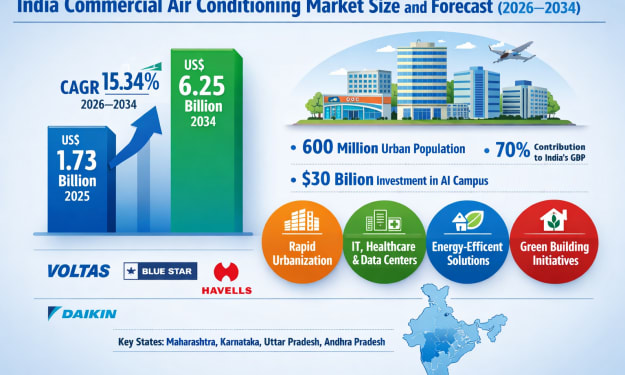
India Commercial Air Conditioning Market Size and Forecast 2026–2034
Introduction India’s commercial infrastructure is expanding at an unprecedented pace, and with it comes a growing need for advanced climate control systems. From modern office complexes and sprawling shopping malls to hospitals, hotels, airports, and data centers, efficient cooling solutions have become essential for operational efficiency and occupant comfort.
By Sakshi Sharma6 days ago in Trader
Australia Data Center Power Market 2026: Cloud Expansion, AI Workloads & Energy-Efficient Infrastructure
Australia Data Center Power Market Overview The Australia data center power market is a crucial component of the country’s digital infrastructure ecosystem, supporting the reliable operation of data centers that power cloud computing, artificial intelligence (AI), enterprise IT services and online platforms. Data center power systems include power distribution units (PDUs), uninterruptible power supplies (UPS), generators, power monitoring systems and energy management solutions that ensure continuous electricity supply and operational reliability.
By Amyra Singha day ago in Trader



Comments
There are no comments for this story
Be the first to respond and start the conversation.