
Waterjet Cutting Machine Market Size and Forecast (2025–2033)
Precision Meets Sustainability: The Expanding Role of Waterjet Cutting in Global Manufacturing

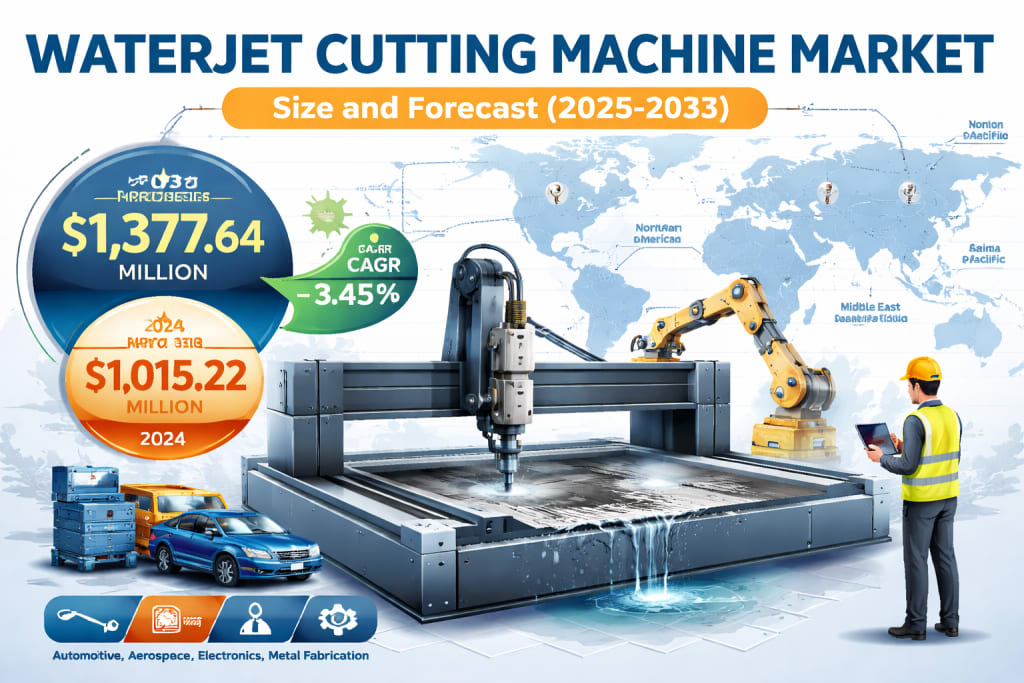
The global Waterjet Cutting Machine Market is steadily evolving as industries demand higher precision, flexibility, and environmentally sustainable manufacturing solutions. According to recent insights, the market is projected to grow from US$ 1,015.22 million in 2024 to US$ 1,377.64 million by 2033, expanding at a CAGR of 3.45% from 2025 to 2033.
Waterjet cutting technology has emerged as a critical component within the broader industrial machinery sector. Known for its ability to cut complex materials without heat distortion, it is widely used across industries such as automotive, aerospace, electronics, construction, and metal fabrication. As global industrialization accelerates and technological advancements reshape production processes, waterjet cutting machines (WCMs) are gaining strong momentum worldwide.
Global Waterjet Cutting Machine Industry Overview
A waterjet cutting machine is an advanced industrial system that utilizes high-pressure streams of water—sometimes combined with abrasive materials—to cut and shape a wide range of materials. These machines can precisely process metals, glass, ceramics, composites, foams, and plastics without causing thermal damage.
Unlike traditional cutting methods such as laser or plasma cutting, waterjet technology does not generate heat. This eliminates risks such as warping, melting, or altering the material’s structural integrity. As a result, it is particularly suitable for heat-sensitive materials like aluminum, titanium, and composites.
Key advantages of waterjet cutting machines include:
Exceptional precision and accuracy
Minimal material wastage
Heat-free cutting process
Versatility across multiple materials
Reduced need for secondary finishing
Due to these benefits, WCMs are extensively used in industries including mining, food processing, aerospace, defense, textiles, and metal fabrication.
Global industrial expansion remains a primary growth driver. Additionally, increased demand from automotive manufacturing—where waterjet machines are used to produce brake discs, gaskets, and complex fittings—is further fueling market growth. In aerospace, the technology plays a vital role in fabricating turbine components and composite structures.
Key Factors Driving Market Growth
1. Rising Demand for Accuracy and Flexibility
Modern manufacturing increasingly requires high precision and customization. Waterjet cutting machines excel in delivering intricate designs with tight tolerances across diverse materials.
Their ability to switch between materials without changing tools significantly improves operational efficiency and reduces production costs. This adaptability is especially valuable in industries such as aerospace, automotive, and electronics, where complex geometries are standard.
As manufacturers shift toward mass customization and flexible production systems, waterjet cutting technology is becoming a preferred solution.
2. Heat-Free Cutting Advantage
One of the most defining features of waterjet cutting is its cold cutting process. Unlike thermal cutting methods, waterjet machines do not create heat-affected zones (HAZ).
This offers several advantages:
Preserves material properties
Prevents deformation and microcracks
Ensures superior surface finish
Reduces post-processing requirements
For industries dealing with sensitive or high-value materials, such as aerospace and defense, this capability is indispensable.
3. Growing Emphasis on Environmental Sustainability
Sustainability is becoming a central focus in industrial operations, and waterjet cutting aligns well with eco-friendly manufacturing practices.
Uses water and natural abrasives instead of harmful chemicals
Produces minimal waste
Enables recycling of water and abrasive materials
Reduces emissions compared to thermal cutting methods
As environmental regulations tighten globally, manufacturers are increasingly adopting waterjet technology to minimize their ecological footprint.
Challenges in the Waterjet Cutting Machine Market
1. High Initial and Operating Costs
Despite its advantages, waterjet cutting technology requires significant investment. Machine costs typically range between US$ 100,000 and US$ 350,000, making it less accessible for small and medium enterprises (SMEs).
Operational expenses also add up over time:
Abrasive materials (e.g., garnet) can cost up to US$ 30 per hour
Energy consumption and maintenance costs remain substantial
Compared to alternatives like laser or plasma cutting, waterjet systems may appear costlier, especially for applications where heat damage is not a concern.
2. Maintenance Requirements and Downtime
Waterjet machines require regular maintenance to ensure optimal performance. Key components such as:
Nozzles
Seals
Intensifiers
must be inspected and replaced periodically.
Failure to maintain these parts can lead to equipment breakdowns, production delays, and increased repair costs. Additionally, sourcing replacement parts and scheduling maintenance can disrupt production cycles.
To address this challenge, companies are increasingly investing in predictive maintenance technologies and automation.
Regional Market Insights
North America
North America dominates the global waterjet cutting machine market, driven by its advanced manufacturing ecosystem. The United States, in particular, leads in adoption due to strong demand from aerospace, automotive, and metal fabrication industries.
Automation and smart manufacturing technologies are increasingly integrated into cutting systems, enhancing productivity and reducing waste.
Europe
Europe emphasizes precision engineering and sustainable manufacturing practices. Countries like Germany are at the forefront, leveraging waterjet technology in automotive and aerospace sectors.
The region also focuses on energy-efficient solutions and integration with CAD/CAM systems, supporting advanced production capabilities.
Asia-Pacific
Asia-Pacific is the fastest-growing region, fueled by rapid industrialization and cost-effective manufacturing.
China plays a significant role due to its massive industrial base and strong demand from electronics, automotive, and metal fabrication sectors. Government initiatives promoting industrial modernization further support market growth.
India, Japan, and Southeast Asian countries are also witnessing increased adoption of advanced cutting technologies.
Middle East & Africa
The market in the Middle East and Africa is expanding steadily, particularly in countries like the United Arab Emirates. Growth is supported by investments in infrastructure, oil & gas, and industrial diversification.
The region’s strategic position as a global trade hub also facilitates access to advanced machinery and technologies.
Latin America
Latin America shows moderate growth, with countries like Brazil and Mexico investing in industrial modernization. Increasing adoption of advanced manufacturing technologies is expected to drive demand in the coming years.
Recent Developments in the Industry
The waterjet cutting machine market continues to evolve through innovation and strategic investments:
July 2024: WECJet introduced the advanced Mach 500 waterjet cutting machine, featuring 90,000 psi dynamic head-cutting technology. This system enhances cutting speed and enables processing of materials up to 300mm thick.
November 2023: WAZER partnered with TriMech to expand access to its desktop CNC waterjet cutter, making waterjet technology more accessible for small-scale production, prototyping, and repair applications.
These developments highlight a shift toward both high-performance industrial systems and compact, accessible solutions.
Market Segmentation Overview
The global waterjet cutting machine market is segmented as follows:
By Type
Pure Waterjet
Abrasive Waterjet
By Product Type
3D Waterjet Cutting
Micro Waterjet Cutting
Robotic Waterjet Cutting
By Horsepower
0–50 HP
51–100 HP
Others
By Machine Size
Small
Medium
Large
By Application
Automotive
Electronics
Aerospace & Defense
Mining
Metal Fabrication
Others
Competitive Landscape
The market is characterized by the presence of several global and regional players focusing on innovation, product development, and strategic partnerships.
Key companies include:
Koike Aronson Inc.
A. Innovative International Limited
Jet Edge Inc.
Colfax Corporation
KMT GmbH
Lincoln Electric Holdings Inc.
Jekran Ltd.
Hypertherm Inc.
Dardi International Corporation
These players are actively investing in R&D to enhance machine efficiency, precision, and automation capabilities.
Final Thoughts
The global waterjet cutting machine market is on a steady growth trajectory, supported by rising industrial demand, technological innovation, and increasing focus on sustainability. While challenges such as high costs and maintenance requirements persist, ongoing advancements in automation, efficiency, and accessibility are expected to offset these barriers.
As industries continue to prioritize precision manufacturing and eco-friendly processes, waterjet cutting technology is poised to play a crucial role in shaping the future of industrial production. From aerospace engineering to automotive manufacturing, its versatility and reliability ensure that it remains a cornerstone of modern fabrication techniques.
In the years ahead, the integration of smart technologies, AI-driven optimization, and compact solutions will likely further expand the market’s reach—making waterjet cutting not just a tool, but a strategic asset in global manufacturing.
About the Creator
United States Biometrics Market Size, Growth, Latest Trends and Forecast 2026-2034
United States Biometrics Market Overview The United States Biometrics Market is experiencing significant growth as organizations increasingly adopt advanced identity verification technologies to improve security and authentication processes. Biometrics refers to the use of unique biological characteristics such as fingerprints, facial recognition, iris patterns, and voice recognition to verify an individual’s identity.
By Jackson Watson6 days ago in Trader



Comments
There are no comments for this story
Be the first to respond and start the conversation.