
The Skeleton Lake of the Himalayas
High in the remote Himalayas lies Roopkund, a glacial lake surrounded by hundreds of ancient human skeletons, creating one of the world’s most fascinating archaeological mysteries.

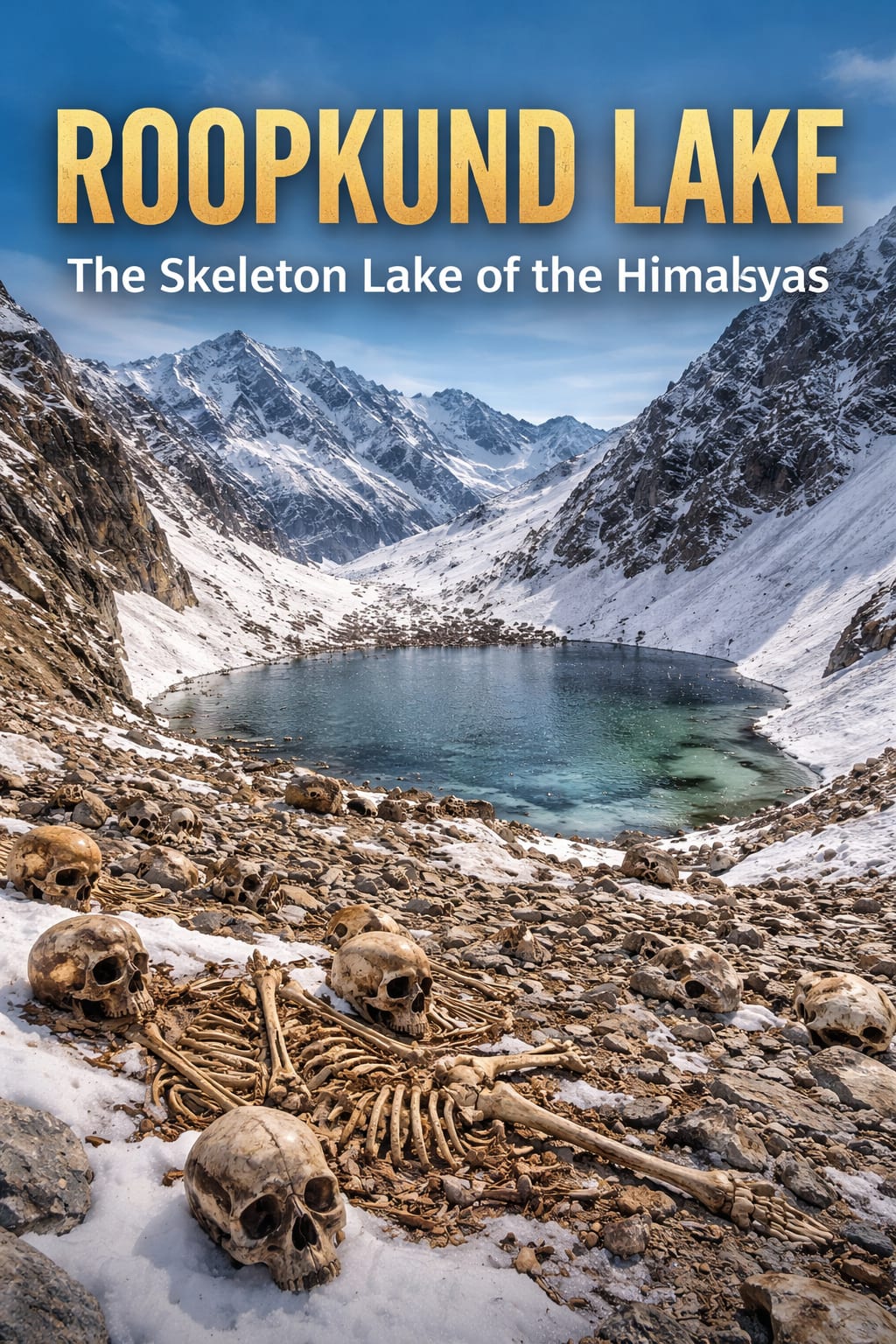
High in the rugged mountains of the Indian Himalayas lies one of the world’s most mysterious and haunting archaeological sites—Roopkund Lake, often called Skeleton Lake. Located at an altitude of about 5,029 meters (16,500 feet) in the Indian state of Uttarakhand, the small glacial lake is surrounded by steep snow-covered peaks. What makes this remote location extraordinary is the presence of hundreds of ancient human skeletons scattered around its shores and beneath its icy waters.
The story of Roopkund’s skeletons first came to global attention in 1942, when a forest ranger named H. K. Madhwal reportedly discovered numerous human bones around the lake. At first, British officials suspected that the skeletons might belong to Japanese soldiers who had attempted to secretly cross the Himalayas during World War II. However, later scientific examinations showed that the remains were far older—centuries before the war.
Roopkund itself is a relatively small lake, measuring roughly 40 meters in diameter. During most of the year, it remains frozen beneath thick ice and snow. When the ice melts during the warmer summer months, the skeletal remains become visible along the lake’s edge. Some skeletons are remarkably well preserved due to the cold climate. In many cases, skulls, bones, and even fragments of clothing and wooden artifacts have survived for hundreds of years.
For decades, researchers struggled to understand who these people were and how they died in such a remote location. Early studies suggested that the remains dated back to around the 9th century CE. A theory soon emerged that these individuals were part of a large group of travelers—possibly pilgrims—who were caught in a sudden and violent natural disaster.
This theory gained significant support after scientists conducted detailed examinations of the skulls. Many skeletons showed signs of unusual, round fractures on the top of their heads. Researchers proposed that these injuries were caused by large hailstones during an extremely severe hailstorm. In the high-altitude environment of the Himalayas, hailstones can grow unusually large and fall with tremendous force. According to this explanation, a group of travelers passing through the mountain valley may have been trapped in an intense storm, with hailstones powerful enough to cause fatal head injuries.
Local folklore offers a similar explanation, though in a more mythical form. According to regional legends, a king named Jasdhaval from the nearby region of Kannauj once traveled to the mountains with a large procession of dancers, servants, and pilgrims. The group was reportedly heading to a sacred shrine in the Himalayas. However, their behavior angered the mountain goddess Nanda Devi, who punished them by unleashing a devastating storm that killed everyone in the party. Many locals believe the skeletons are the remains of this ill-fated pilgrimage.
In recent years, modern science has added new layers to the mystery. In 2019, researchers conducted extensive DNA analysis on dozens of the skeletons. Surprisingly, the results revealed that the remains did not all belong to a single group from the same time period. Instead, they represented multiple groups of people who died at Roopkund centuries apart.
Even more intriguing was the discovery that some of the individuals had Mediterranean ancestry, genetically similar to people from regions such as Greece or Crete. These individuals likely died around the 19th century, suggesting that Roopkund may have attracted travelers from distant parts of the world. Exactly why they were present in such a remote Himalayan location remains unclear.
These findings dramatically changed the earlier narrative. Rather than a single tragic event, Roopkund appears to have witnessed multiple incidents involving different groups of people over many centuries. Some may have been pilgrims traveling to sacred Himalayan shrines, while others might have been explorers, traders, or travelers following ancient mountain routes.
Today, Roopkund Lake is both a fascinating archaeological site and a popular trekking destination. Adventurers who undertake the difficult journey through steep valleys and alpine meadows can still see the scattered bones along the lake’s edge when the ice melts. However, the site is also treated with respect due to its historical and cultural significance.
Despite decades of research, many questions remain unanswered. Why were people from distant regions traveling to such a remote place? What events caused their deaths? And how many more secrets remain hidden beneath the lake’s icy waters?
Roopkund continues to intrigue scientists, historians, and travelers alike. Perched high among the Himalayan peaks, the mysterious Skeleton Lake stands as a silent reminder of humanity’s long and often unexplained journeys through the mountains. Even today, the haunting presence of hundreds of ancient skeletons ensures that Roopkund remains one of the most enigmatic archaeological mysteries in the world.
About the Creator
Irshad Abbasi
Ali ibn Abi Talib (RA) said 📚
“Knowledge is better than wealth, because knowledge protects you, while you have to protect wealth.
Keep reading
More stories from Irshad Abbasi and writers in Earth and other communities.
The Mystery of Skeleton Lake
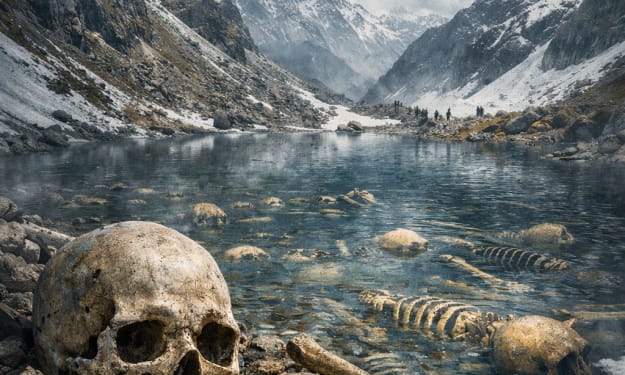
Hidden high in the rugged mountains of the Indian Himalayas lies one of the world’s most mysterious archaeological sites: Roopkund Lake, widely known as “Skeleton Lake.” Nestled at an altitude of more than 5,000 meters (16,500 feet), this small glacial lake becomes visible only when the snow melts during warmer months. What makes the site extraordinary is the eerie discovery of hundreds of human skeletons scattered around and inside the lake, creating one of the greatest unsolved mysteries in the Himalayas.
By Irshad Abbasi about 9 hours ago in Earth
The Ghost Metal of Cyprus
She almost put it back. A geologist crouching in the dry scrubland outside Lakia, Cyprus, turned a small rock over in her hand and nearly dismissed it. The colour was wrong. Gold is not supposed to look like that. It was not yellow. It was not even close.
By CurlsAndCommas7 days ago in Earth
Hormuz on Fire
Hormuz on Fire The narrow waters of the Strait of Hormuz have once again become one of the most dangerous flashpoints on Earth. Located between Iran and the Arabian Peninsula, this strategic passage connects the Persian Gulf to the Gulf of Oman and ultimately to the global ocean. Though small in size, the strait carries enormous global importance. Nearly one-fifth of the world’s oil supply passes through this narrow corridor every day.
By Wings of Time a day ago in Earth



Comments
There are no comments for this story
Be the first to respond and start the conversation.