
Real Estate Market Encouraged Growth To USD 10038 Billion by 2033 at 4.8% CAGR
Global Real Estate Market: 2024–2033 Analysis and Forecast

Overview
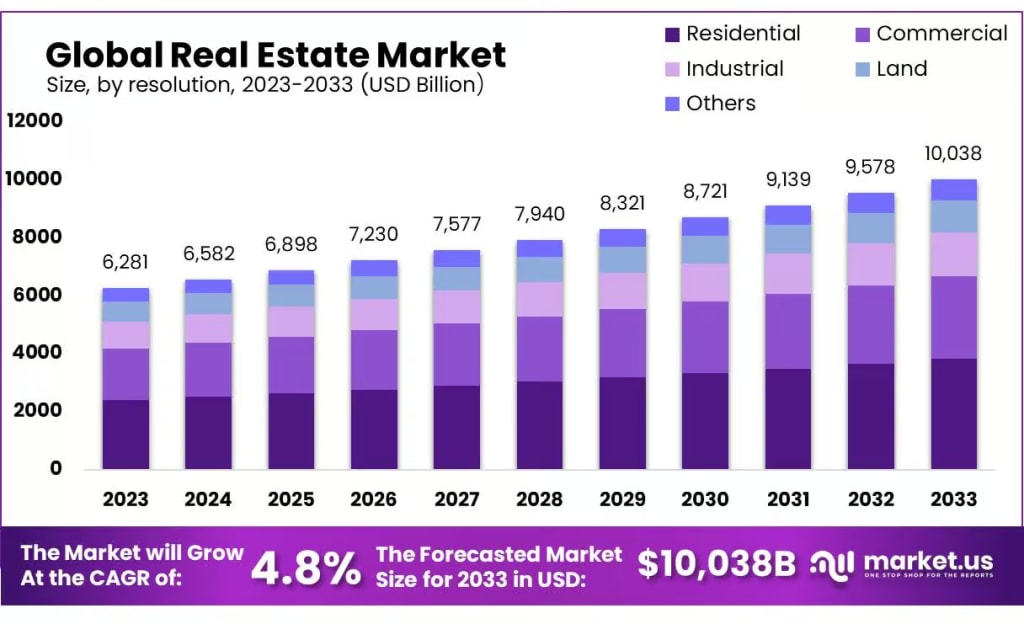
The Global Real Estate Market is on a strong growth trajectory. Valued at USD 6,281 billion in 2023, the market is forecasted to reach approximately USD 10,038 billion by 2033. This expansion represents a steady compound annual growth rate (CAGR) of 4.8% over the forecast period. The industry’s performance is shaped by a complex interplay of factors, including demographic trends, technological advancements, geopolitical shifts, and broader economic conditions.
Real estate remains a cornerstone of global investment, valued for its stability and long-term appreciation potential. Market dynamics, however, are not uniform. They vary significantly by region and country, influenced by local interest rates, government policies, and supply-demand balances. For example, the residential sector is the primary driver in the United States, whereas commercial real estate leads growth in China.
Key Takeaways
- The Global Real Estate Market is projected to grow from USD 6,281 billion by 2023 to USD 10,038 billion by 2033 at a 4.8% CAGR.
- The Residential sector led the market with a 38.3% share in 2024, underscoring persistent global demand for housing.
- Fully furnished properties were the top choice, holding a 41.6% market share in 2024.
- The Rental model accounted for the majority (54.5% share in 2024), driven by the demand for flexibility.
- Despite the digital shift, Offline transactions (agents, in-person) dominated with 76.3% of the market in 2024, though online channels are poised for rapid growth.
- The Asia Pacific region was the global leader, capturing a commanding 53% market share in 2024, fueled by rapid urbanization and economic development.
By Property Type
In 2024, the Residential Segment was the market leader, accounting for over 38.3% of global revenue. This segment, comprising single-family homes, apartments, and condominiums, is fundamental to meeting the basic housing needs of populations worldwide. The Commercial Real Estate segment also held a significant share, encompassing office buildings, retail spaces, and hotels, attracting investors seeking business opportunities and rental income.
By Furnishing Type
Fully Furnished Properties were the most popular choice in 2024, capturing over 41.6% of the market. Their appeal lies in the convenience of immediate occupancy, as they come equipped with furniture and appliances. Semi-Furnished Properties, offering essential fixtures and allowing for personalization, held a notable share. Unfurnished Properties, while representing a smaller portion of the market, remain relevant for tenants and buyers seeking maximum flexibility and lower upfront costs.
By Business Model
The Rental Segment was the dominant business model in 2024, holding over 54.5% of the market share. This model caters to users seeking flexibility through periodic payments for temporary residential or commercial use. Property Sales, involving the outright transfer of ownership, represented a significant portion of the market, appealing to those seeking long-term investment and asset control. Leasing, characterized by long-term contractual agreements, remains a crucial model for businesses and organizations seeking stability.
By Transaction Mode
Offline Transactions were the preferred method in 2024, commanding over 76.3% of the market. This traditional approach, involving physical offices, agents, and in-person viewings, is favored by those who value personalized, face-to-face interactions. Online Transactions, though currently a smaller segment, are experiencing rapid growth. Digital platforms and apps are gaining traction by offering tech-savvy users convenience and efficiency in property searches and transactions.
Regional Analysis: Asia Pacific Takes the Lead
The Asia Pacific region solidified its dominance in the global real estate market in 2024, securing an impressive 53% share. This leadership is driven by a confluence of powerful factors: rapid urbanization, significant population growth, and extensive infrastructure development. China and India are the primary engines of this growth, with their booming economies and massive urbanization projects fueling demand across residential, commercial, and industrial property sectors.
These countries have emerged as global hubs for real estate investment and development. The region's strength is further amplified by diverse demand from sectors like retail, hospitality, healthcare, and education. Leveraging robust construction capabilities, Asia Pacific is well-positioned to meet its growing infrastructural and property needs, cementing its role as the market's key growth driver.
Top Industry Use Cases
- AI-Driven Property Valuation: Algorithms analyze historical data, location, and market trends to deliver accurate property price predictions. This empowers buyers and sellers to make informed decisions, helps agents set competitive prices, and enables investors to identify undervalued opportunities.
- Immersive Virtual Tours: AI-powered platforms offer 3D virtual tours, allowing potential buyers to explore properties remotely. This technology saves significant time for both clients and agents, accelerates the decision-making process, and is particularly valuable for out-of-town or international buyers.
- Advanced Market Analytics: By processing vast datasets on sales, rentals, and economic indicators, analysts can identify emerging market trends. These insights guide developers on where to build and help investors time their entry and exit strategies effectively.
- Intelligent Lead Generation: AI tools track and analyze online behavior—such as website visits and social media engagement—to identify high-potential leads. This allows agents to focus their efforts on serious prospects, improving conversion rates and sales efficiency.
- Proactive Fraud Detection: AI algorithms scrutinize property listings and transaction data for anomalies indicative of fraud, such as inflated valuations or forged documents. This protects all parties involved, ensures safer transactions, and helps maintain trust and integrity in the market.
Recent Strategic Developments
- Brookfield Asset Management Inc.: The firm is aggressively pivoting towards sustainable investing by expanding its renewable energy and transition investments. This includes launching a major global decarbonization fund, positioning its extensive real assets for a lower-carbon future while seeking strong returns.
- CBRE Global Investors (now IQON Capital): Following its acquisition, the firm was rebranded as IQON Capital in 2024. The new entity is focusing on a technology-forward approach, leveraging data analytics to enhance its global real estate investment and portfolio management strategies.
- CBRE Group, Inc.: CBRE is making significant investments in artificial intelligence, including the launch of a generative AI tool to assist clients with office space optimization. The firm continues to lead in property sales and advisory, using technology to enhance client services across all its business lines.
- Colliers International Group Inc.: Colliers is pursuing strategic growth through acquisitions, particularly in high-demand areas like project management, data centers, and renewable energy infrastructure. This strategy, combined with a culture of entrepreneurial leadership, aims to capture market share in specialized real estate sectors.
- Cushman & Wakefield: The company is bolstering its capital markets and valuation advisory services. It is also prioritizing the development of insights on key trends like the evolution of office spaces and logistics, helping clients navigate a market reshaped by hybrid work models and economic shifts.
Conclusion
The Global Real Estate Market is poised for sustained growth, driven by fundamental demand for housing, rapid urbanization, and the integration of advanced technologies. The adoption of AI and data analytics is revolutionizing how properties are valued, marketed, and transacted, creating new efficiencies and enhancing security. With strong regional tailwinds in the Asia Pacific and a clear shift towards data-driven decision-making, the industry is well-positioned to meet the evolving needs of a global population, from the rise of remote work to the increasing demand for sustainable living and investment options.
About the Creator
Hayden Kulas
I am blogger, digital marketing pro since 5 years and writes for Market.us. Computer Engineer by profession. I love to find new ideas that improve websites' SEO. He enjoys sharing knowledge and information about many topics.
Keep reading
More stories from Hayden Kulas and writers in Futurism and other communities.
Craft Beer Market Worth USD 282.6 Billion by 2032 at 10.6% CAGR
Overview The Global Craft Beer Market is on a strong growth trajectory, with its value projected to surge from USD 114.1 billion in 2023 to USD 282.6 billion by 2032. This represents a robust compound annual growth rate (CAGR) of 10.6% over the forecast period. North America is the current market leader, commanding a 38% share of global sales in 2023, a position solidified by its deep-rooted beer culture and vast network of independent breweries.
By Hayden Kulasabout 4 hours ago in Futurism
Saudi Arabia Plant-Based Condiments Market: Vegan Trends, Clean Label Products & Growth Outlook
Rising health awareness, busy lifestyles, and preference for convenient, plant-based options are driving demand in Saudi Arabia's condiments market, supported by Vision 2030 initiatives, clean-label trends, product innovation, and expanding retail channels. According to IMARC Group's latest data, the Saudi Arabia plant-based condiments market size was valued at USD 2,380.57 Million in 2025. Looking forward, IMARC Group estimates the market to reach USD 3,469.78 Million by 2034, exhibiting a CAGR of 4.28% from 2026-2034. Vegetables and fruits currently dominate the market, holding a market share of 48% in 2025.
By Shubham Sharma a day ago in Futurism
Australia Electric Vehicle (EV) Charging Market: Fast-Charging Infrastructure Expansion, Smart Charging Technologies & Public-Private Investments
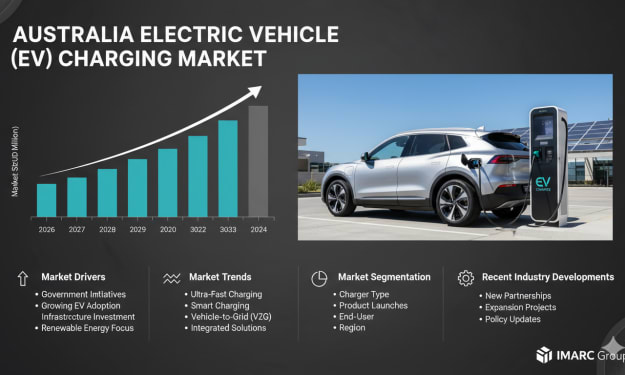
According to IMARC Group, the Australia electric vehicle (EV) charging market reached a value of USD 304.4 Million in 2025 and is projected to reach USD 1,692.2 Million by 2034, growing at a compound annual growth rate (CAGR) of 21.00% during 2026–2034. The market is expanding rapidly as Australia accelerates the adoption of electric mobility and transitions toward a low-carbon transportation ecosystem. Electric vehicle charging infrastructure plays a critical role in supporting EV adoption by ensuring convenient and reliable access to charging services across cities, highways and regional areas. Governments and private sector stakeholders are investing heavily in public charging networks, fast-charging corridors and residential charging solutions. Technological advancements such as smart charging platforms, vehicle-to-grid (V2G) systems and integrated energy management solutions are also transforming the EV charging ecosystem. As electric vehicle ownership continues increasing and policy support strengthens nationwide charging infrastructure development, Australia’s EV charging market is becoming a cornerstone of the country’s sustainable mobility strategy.
By Kevin Cooper4 days ago in Futurism
Sometimes It's Like That and That'sThe Way It Is
It was the late 1960s, and ten-year-old Gloria Coleman was standing with her grandmother on the side of the highway waiting for the bus. As the Greyhound pulled up, it seemed monstrous and intimidating. Grandma Elizabeth grabbed Gloria's hand, holding it tightly as they boarded.
By Cheryl E Preston4 days ago in Fiction



Comments
There are no comments for this story
Be the first to respond and start the conversation.