Latest Stories
Most recently published stories in Futurism.
Automotive Artificial Intelligence Market Trends: Edge AI, Connected Car Ecosystems & Industry Outlook to 2033. AI-Generated.
The global push for smarter, safer, and more autonomous mobility is fundamentally reshaping the automotive landscape, with artificial intelligence serving as the primary engine of this transformation. According to IMARC Group’s latest data, the global automotive artificial intelligence market size was valued at USD 5.0 Billion in 2024. Looking forward, IMARC Group estimates the market to reach USD 47.3 Billion by 2033, exhibiting a CAGR of 25.3% from 2025-2033.
By Andrew Sullivanabout 5 hours ago in Futurism
Mobile App Development Companies in Dubai: A Detailed Overview (2026)
Dubai has steadily established itself as one of the leading technology and innovation hubs in the Middle East. With strong government initiatives, smart city development, and a growing startup ecosystem, businesses across industries are increasingly investing in digital solutions.
By Apptunix usaabout 5 hours ago in Futurism
Oats Market Outlook: Innovation in Oat Snacks, Consumer Preferences & Industry Forecast to 2034. AI-Generated.
Rising health awareness, expanding plant-based diets, and the demand for fiber-rich breakfast options are driving oats demand, supported by clean-label trends, product innovation in dairy alternatives, and a shift toward functional ingredients. According to IMARC Group’s latest data, the global oats market size reached USD 5.68 Billion in 2025. Looking forward, IMARC Group estimates the market to reach USD 6.62 Billion by 2034, exhibiting a CAGR of 1.63% from 2026-2034. Russia currently dominates the market, holding the largest market share in 2025 due to extensive production and high domestic consumption.
By Andrew Sullivanabout 5 hours ago in Futurism
Ferrosilicon Market Outlook: Steel Production Demand and Metallurgical Growth Opportunities. AI-Generated.
According to IMARC Group's latest research publication, The global ferrosilicon market size reached USD 12.8 Billion in 2025. Looking forward, IMARC Group expects the market to reach USD 15.4 Billion by 2034, exhibiting a growth rate (CAGR) of 2.00% during 2026-2034.
By James Whitmanabout 6 hours ago in Futurism
Flexible Packaging Market Outlook: Sustainable Packaging Demand and Consumer Goods Expansion Opportunities. AI-Generated.
According to IMARC Group's latest research publication, The global flexible packaging market size reached USD 146.0 Billion in 2025. Looking forward, IMARC Group estimates the market to reach USD 243.7 Billion by 2034, exhibiting a growth rate CAGR of 5.57% from 2026-2034.
By James Whitmanabout 6 hours ago in Futurism
Biscuits Market Outlook: Convenience Food Demand and Snacking Trends Growth Opportunities. AI-Generated.
According to IMARC Group's latest research publication, The global biscuits market size was valued at USD 134.1 Billion in 2025. Looking forward, IMARC Group estimates the market to reach USD 191.4 Billion by 2034, exhibiting a CAGR of 4.00% from 2026-2034.
By James Whitmanabout 6 hours ago in Futurism
Petrochemicals Market Outlook: Industrial Demand Expansion and Chemical Manufacturing Growth Opportunities. AI-Generated.
According to IMARC Group's latest research publication, The global petrochemicals market size reached USD 675.7 Billion in 2025. Looking forward, IMARC Group expects the market to reach USD 996.1 Billion by 2034, exhibiting a growth rate (CAGR) of 4.40% during 2026-2034.
By James Whitmanabout 6 hours ago in Futurism
Online Travel Market Outlook: Digital Booking Platforms and Global Tourism Growth Opportunities. AI-Generated.
According to IMARC Group's latest research publication, The global online travel market size was valued at USD 622.6 Billion in 2025. Looking forward, IMARC Group estimates the market to reach USD 1,438.4 Billion by 2034, exhibiting a CAGR of 9.75% during 2026-2034.
By James Whitmanabout 6 hours ago in Futurism
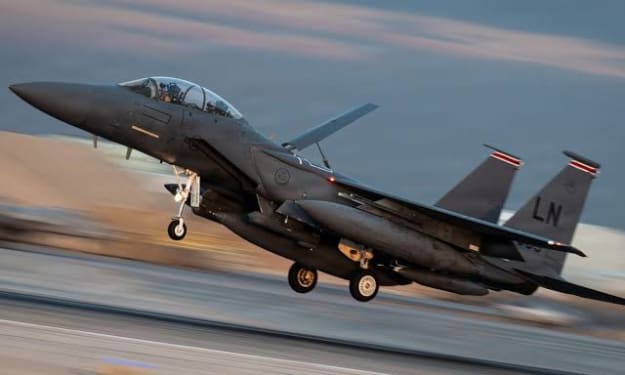
F-15E Strike Eagles, deployed during Operation Epic Fury, can fly 2.5 times the speed of sound. Take a closer look. AI-Generated.
When it comes to modern airpower, few aircraft command as much respect as the F-15E Strike Eagle. Known for its raw speed, heavy payload capacity, and advanced avionics, the aircraft has once again captured attention following its reported deployment during Operation Epic Fury. Capable of reaching speeds of up to Mach 2.5—more than twice the speed of sound—the F-15E remains one of the fastest and most formidable strike fighters in active service today. But beyond its headline-grabbing speed lies a complex system designed for precision, endurance, and battlefield dominance. A Legacy of Power and Evolution The Strike Eagle is a variant of the original F-15 platform, developed by Boeing (formerly McDonnell Douglas). While the earlier F-15 models were designed primarily for air superiority, the F-15E was engineered as a dual-role fighter capable of both air-to-air combat and deep strike missions. This evolution transformed the aircraft into a versatile platform that can operate in all weather conditions, day or night. Its reinforced airframe allows it to carry a wide array of weapons, including precision-guided munitions, making it a critical asset in modern warfare. Speed and Performance One of the defining features of the F-15E is its incredible speed. At Mach 2.5, it can travel at approximately 3,000 kilometers per hour, depending on altitude and configuration. This allows the aircraft to rapidly respond to threats, intercept hostile targets, and execute missions with minimal warning. Speed is complemented by a powerful twin-engine setup, giving the Strike Eagle exceptional thrust and maneuverability. Even when fully loaded with weapons and fuel, the aircraft maintains impressive performance characteristics. Its long-range capability is equally notable. With conformal fuel tanks and aerial refueling support, the F-15E can conduct extended missions far beyond its home base, making it ideal for operations in distant or contested regions. Precision Strike Capabilities While speed is a major advantage, the true strength of the F-15E lies in its precision strike capabilities. Equipped with advanced targeting systems, the aircraft can identify and engage targets with remarkable accuracy. Its onboard radar and navigation systems allow pilots to operate in low-visibility conditions, while modern targeting pods enhance its ability to strike moving and stationary targets alike. The Strike Eagle can carry a diverse arsenal, ranging from air-to-air missiles to laser-guided bombs. This flexibility ensures that it can adapt to a wide range of mission requirements, from close air support to strategic bombing. Role in Operation Epic Fury During Operation Epic Fury, the F-15E reportedly played a central role in demonstrating air superiority and precision strike capability. Although details of the operation remain limited, defense analysts suggest that the deployment highlights the continued relevance of the aircraft in modern conflict scenarios. The operation is believed to have involved coordinated air missions designed to deter threats and secure key strategic areas. In such environments, the F-15E’s combination of speed, payload, and advanced systems provides a decisive edge. Advanced Technology and Crew Coordination Unlike many fighter jets, the F-15E is operated by a two-person crew: a pilot and a weapons systems officer (WSO). This division of responsibilities allows for more effective mission management, particularly during complex operations. The cockpit is equipped with cutting-edge avionics, including digital displays and advanced communication systems. These technologies enable real-time data sharing and situational awareness, which are critical in fast-paced combat environments. The aircraft also incorporates electronic warfare capabilities, allowing it to counter enemy radar and missile systems. This enhances survivability and increases the likelihood of mission success. Enduring Relevance in Modern Warfare Despite the emergence of newer stealth aircraft, the F-15E continues to play a vital role in military operations. Its ability to carry large payloads and operate over long distances ensures that it remains a valuable asset for air forces around the world. Moreover, ongoing upgrades are extending the aircraft’s service life and enhancing its capabilities. Improvements in radar systems, weapons integration, and communication technologies are keeping the Strike Eagle competitive in an evolving threat landscape. Looking Ahead As global security challenges continue to evolve, platforms like the F-15E Strike Eagle demonstrate the importance of combining speed, precision, and versatility. Whether deployed in high-intensity conflict or strategic deterrence missions, the aircraft remains a cornerstone of modern airpower. Its performance during Operation Epic Fury serves as a reminder that even in an era of rapid technological change, proven platforms can still deliver exceptional results. In the skies above contested regions, the Strike Eagle continues to live up to its name—fast, powerful, and ready to strike with precision when it matters most.
By Fiaz Ahmed about 6 hours ago in Futurism
Apple’s 2026 Gamble: 7 Surprising Takeaways From the iPhone 18 Leaks
For over a decade, the "September iPhone" has been the most predictable beat in technology. Like clockwork, Apple delivers four new models, a slightly faster chip, and a new camera trick. It is a ritual of incrementalism that has served the company’s bottom line, but perhaps not the consumer’s imagination. If the current flood of leaks from the Shenzhen supply chain and South Korean financial analysts is to be believed, 2026 is the year the clock stops.
By Tech Horizonsabout 10 hours ago in Futurism